 English
 Chinese
 Pусский
 Español
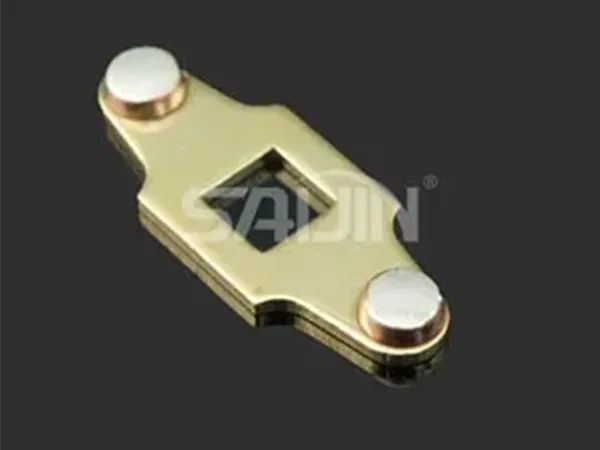
A stamped bridge body with contact faces built in three possible ways — riveted on, welded on, or pressed out of clad metal in one stamping pass. Automatic Riveting Stamping Parts are the metal load-bearing pieces inside a switching assembly, carrying current between the terminal end and the contact face. Here's how the three component types differ, which metals form the body, and how a custom part gets made.
What the Three Component Types Are
What Is a Riveting Part?
A riveting part joins a contact to a copper component by riveting: the contact is set on the copper body and fastened with a rivet head, so the contact face and the load body come from two pieces assembled afterward. This type leaves the contact alloy on the wearing face while the body keeps the copper's current-carrying shape.
What Is a Welding Part?
A welding part joins a sheet contact to the copper component by welding instead of riveting. The contact sheet is placed along the edge or end of the copper body and fused in place, which suits parts where the joint needs a flatter profile than a rivet head leaves.
What Is a Stamping Part?
A stamping part presses precious clad metal directly into the contact bridge component. The clad strip carries the contact layer over the base metal, and the stamping forms the bridge shape in one part, with the contact face already built into the stamped outline rather than added as a separate piece afterward.
Where the Components Go to Work
The Low-Voltage Apparatus List
The contact components are listed for use in switches, relays, thermostats, contactors, disconnectors, controllers, and timers, along with other low-voltage apparatus. In each device the part does the same job: it carries the circuit current to the contact face and provides the mechanical shape that the switch or relay mechanism moves. The application list covers both manual-operated switches and relay-style parts that cycle under control signals.
What Base Metals the Stampings Use
Copper and Brass
The listed base metals are copper, brass, and stainless steel, among others. Copper supplies high current-carrying capacity for the body, while brass offers stiffness and shape-holding for stamped brackets and bridge outlines. The base metal is chosen around how much current the part carries and how rigid the moving body needs to be inside the device.
Stainless Steel and Other Alloys
Stainless steel enters where the body needs extra rigidity or resistance to the working environment, and the material list leaves room for other alloys matched to a specific requirement. Because the contact face can be added by riveting, welding, or clad stamping, the base metal and the contact alloy can be selected independently for the same part.
How the Shop Makes and Checks the Parts
Equipment and Annual Output
The line runs digital and automotive welding stamping machines, riveting machines, welding automatons, high-speed stampers, and standard stampers, with colored metallography, a microscope, and a 3D coordinator for inspection. Contact components are developed and manufactured to the customer's specific requirements, and the listed annual output can surpass one billion pieces. That combination — forming equipment plus inspection equipment — is what keeps stamped bridges and riveted contacts consistent across high-volume runs.
The Component Types at a Glance
What the Product Page Lists Up Front
The table groups the three joining methods, base metals, applications, and equipment exactly as listed, so a designer can match the component type to the device before sending a drawing.
| Item | Detail |
|---|---|
| Product | Mental Stamping Parts for Switches |
| Category | Automatic riveting stamping parts, switch stamped parts |
| Riveting parts | Contact riveted on copper component |
| Welding parts | Sheet contact welded on copper component |
| Stamping parts | Precious clad metal stamped into contact bridge component |
| Base materials | Copper, brass, stainless steel, etc. |
| Applications | Switches, relays, thermostats, contactors, disconnectors, controllers, timers, other low-voltage apparatus |
| Equipment | Welding stamping machine, riveting machine, welding automaton, high-speed stamper, stamper, metallography, microscope, 3D coordinator |
| Listed capacity | Output surpassing one billion pieces annually |
| Customization | Off-standard sizes, shaped structures, special performance requirements |
What the Application List Covers
The application list splits into switching and control apparatus: switches and contactors handle load make-and-break, relays and timers carry signal and timing duty, thermostats open on temperature change, and controllers and disconnectors manage circuit sections. A part that looks like a simple bracket often bridges these roles, which is why the body shape, base metal, and contact method are chosen together.
How Custom Shapes and Sizes Are Handled
Off-Standard Dimensions and Special Performance
Customers around the globe request deeply customized metal stampings and electrical connection components, ranging from off-standard sizes and shaped structures to special performance requirements. That means a part isn't limited to a standard bridge outline: the stamped shape, terminal arrangement, contact position, and base metal can follow the device design, with the contact method — rivet, weld, or clad stamping — picked to fit how the part assembles in the final apparatus.
Saijin, the Parts, and the Enquiry
What the Manufacturer Supplies
China Saijin Electrical Alloy, under the SAIJIN brand, supplies the Mental Stamping Parts for Switches alongside the wider automatic riveting and stamping part range, covering riveted, welded, and clad-stamped contact components for low-voltage apparatus. The shop develops parts to customer specifications and runs high-volume production with metallographic, microscope, and 3D inspection alongside the forming equipment.
What to Send With the Enquiry
Send these so the component type and material can be selected on the first pass:
- The device: switch, relay, contactor, thermostat, controller, timer, or another low-voltage apparatus.
- The component type you want: riveted contact, welded sheet contact, or clad-metal stamped bridge.
- Base material preference: copper, brass, stainless steel, or a material matched to a sample.
- The drawing, sketch, or sample showing outline, terminal shape, hole positions, and contact placement.
- Annual quantity and any performance requirements: current duty, cycle rate, or environmental conditions.
An Automatic Riveting Stamping Parts order is settled by the component type and the base material first, so those two details narrow the forming method before the drawing is checked against the production line.
Send the Drawing and the Component Type
What to Put in the Message
Put the device type, the joining method, and the base material in the first note. Those three decide which production route the part follows; the drawing and quantity follow after.
Send them through our request a quotation form and we'll come back with Automatic Riveting Stamping Parts matched to your switch design, base material, and volume target.