 English
 Chinese
 Pусский
 Español
Silver prices continue to climb, and for manufacturers of switches, relays, and contactors, the cost of silver-bearing contact materials is a pressing concern. A Bimetal Rivet Contact made entirely of silver alloy delivers excellent performance, but at a price that erodes margins. The Ag/Cu Bimetal Contact Rivets from Saijin take a different approach: use silver only where it performs its electrical function, and copper everywhere else. This article explains how bimetal construction cuts material costs without sacrificing performance, what the copper substrate contributes beyond cost savings, and how to specify the right configuration for your switching application.
What Buyers Ask About Bimetal Contact Rivets
Silver Content and Material Options
Q: How much silver is actually in a bimetal rivet contact?
A: The silver alloy layer is applied only to the contact face — the surface that makes and breaks electrical contact. The shank and the remainder of the head are copper. This concentrates the expensive silver where it performs its function, rather than distributing it throughout the rivet body.
Q: What silver alloy options are available for the contact layer?
A: The contact layer can be made from Ag, FAg, AgNi, AgCdO, AgSnO2, AgSnO2In2O3, AgZnO, or AgCu. This range covers low-voltage control circuits through medium-power switching applications. The base material is always copper.
Construction and Performance
Q: Does reducing silver content affect electrical performance?
A: The contact resistance remains low, and the silver layer still provides the arc erosion resistance needed for reliable switching. The copper substrate actually improves heat conduction, which helps dissipate thermal energy away from the contact point.
Q: What standard dimensions are available?
A: Bimetal rivet contacts are available in a range of standard dimensions. Shank diameter typically ranges from Φ1.2mm to Φ1.65mm, head diameter from 2.5mm to 3.0mm, head thickness from 0.6mm to 1.0mm, layer thickness from 0.3mm to 0.4mm, and shank length from 0.8mm to 2.5mm. Customization is available per customer drawings.
Why Silver Is Used Only Where It Matters
A solid silver contact rivet uses silver for the contact face, the shank, and the head. But silver's unique properties — low contact resistance, resistance to arc erosion, and resistance to welding — only matter at the contact face. The shank is a mechanical fastener; its job is to hold the rivet in place and conduct current to the terminal. Copper does that job as well as silver, at a fraction of the cost. The bimetal design separates the functions: silver for the electrical interface, copper for the mechanical and conductive path. The metallurgical bond between the two materials ensures they don't separate under thermal cycling or mechanical stress. This isn't a compromise — it's a functional optimization that delivers the same switching performance at a lower material cost.
What the Copper Substrate Contributes Beyond Cost
Copper conducts heat better than silver alloys, so the substrate pulls thermal energy away from the contact point more efficiently. That reduces the temperature rise at the contact face, which extends the life of the silver layer. Copper also provides the mechanical strength needed for the riveting process — the shank must deform and hold securely. And because copper has lower bulk resistance than silver alloys, the overall voltage drop across the rivet is actually lower than an all-silver design.
How Silver Layer Thickness Affects Cost and Life
The silver layer thickness is a design variable. Thicker layers last longer under high switching loads but cost more. Thinner layers reduce cost but may wear through faster in demanding applications. The manufacturer offers customization based on customer drawings, so designers can specify the silver thickness that matches their expected electrical life and budget. Standard layer thickness ranges from 0.3mm to 0.4mm.
Specifications Across the Ag/Cu Bimetal Contact Rivet Range
| Parameter | Specification |
|---|---|
| Contact Material | Ag, FAg, AgNi, AgCdO, AgSnO2, AgSnO2In2O3, AgZnO, AgCu |
| Base Material | Copper |
| Head Diameter (D) | 2.5–3.0mm |
| Head Thickness (T) | 0.6–1.0mm |
| Layer Thickness (S) | 0.3–0.4mm |
| Shank Diameter (d) | Φ1.2–Φ1.65mm |
| Shank Length (L) | 0.8–2.5mm |
| Customization | Available per customer drawings |
| Primary Applications | Switches, relays, contactors, thermostats, automotive electrical |
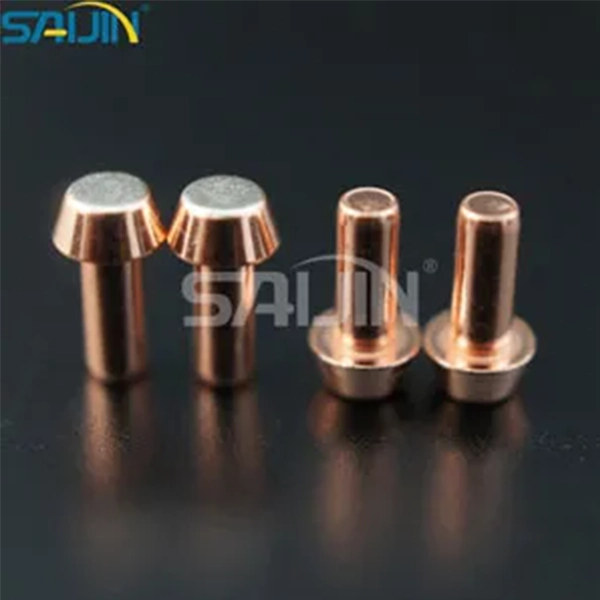
Where Ag/Cu Bimetal Contact Rivets Are Used
The bimetal design is most valuable in applications where material cost is a significant factor and electrical performance must be maintained:
Household Appliance Switches
Ovens, washing machines, and air conditioners use switches that cycle thousands of times. The bimetal construction keeps costs down while maintaining reliable switching performance. The copper substrate manages heat, extending contact life.
Automotive Electrical Systems
Automotive relays, flashers, and control modules operate under vibration and temperature extremes. The bimetal rivet provides a secure mechanical connection, while the silver contact layer maintains low resistance across temperature cycles.
Industrial Control Contactors
Industrial contactors and relays handle higher currents and more frequent switching. The AgCdO or AgSnO2 options deliver the arc erosion resistance needed for these demanding applications, while the copper substrate manages heat buildup.
Temperature Controllers and Timers
Devices that switch on and off frequently rely on contacts that don't degrade quickly. The low contact resistance and arc resistance of the bimetal rivet ensure consistent performance over years of operation.
Common Questions About Bimetal Contact Selection
Q: What's the difference between bimetal and trimetal contacts?
A: Bimetal contacts have a silver contact face and a copper base. Trimetal contacts add a second silver layer on the shank end, creating a sandwich structure (Ag/Cu/Ag). Trimetal contacts are used when both sides of the rivet need contact surfaces, such as double-sided moving contacts in relays.
Q: How do I choose the right silver alloy for my application?
A: Match the alloy to the switching load. AgNi is suitable for low to medium switching loads. AgCdO provides superior resistance to welding but is being phased out in some regions due to cadmium toxicity. AgSnO2 is the environmentally friendly alternative, offering comparable performance without cadmium. AgCu offers good conductivity for general-purpose applications.
Q: What maintenance do bimetal contact rivets require?
A: Bimetal contact rivets are designed for long service life with minimal maintenance. Periodic inspection of the contact surfaces for pitting or erosion is recommended. If contact resistance increases beyond the specified limit, the rivet should be replaced.
Q: Can the rivet be customized for specific assembly requirements?
A: Yes. The manufacturer offers customization based on customer drawings. Head diameter, shank diameter, shank length, layer thickness, and silver alloy composition can all be adjusted to match specific switching load and assembly requirements.
Request a Bimetal Contact Rivet Configuration
A Bimetal Rivet Contact with Ag/Cu construction, silver layer only where it performs, and copper substrate for heat dissipation is the practical choice for switch and relay designers who need reliable current transfer without excessive silver cost. The Ag/Cu Bimetal Contact Rivets from Saijin deliver Ag, FAg, AgNi, AgCdO, AgSnO2, AgSnO2In2O3, AgZnO, or AgCu contact material options, standard dimensions from Φ1.2mm shank diameter to 3.0mm head diameter, layer thickness of 0.3–0.4mm, and full customization based on customer drawings.
Whether you're designing household appliance switches, automotive relays, or industrial control contactors, this bimetal contact rivet offers the material efficiency and electrical performance that cost-conscious switching applications demand. With a metallurgical bond between the silver layer and copper substrate, it maintains performance across thermal cycling and vibration.
Contact Saijin for a bimetal contact rivet configuration assessment → their team can help you select the right alloy combination, dimensions, and silver layer thickness for your specific switching load and assembly requirements. Get a contact that performs where it matters — without paying for silver where it doesn't.