 English
 Chinese
 Pусский
 Español
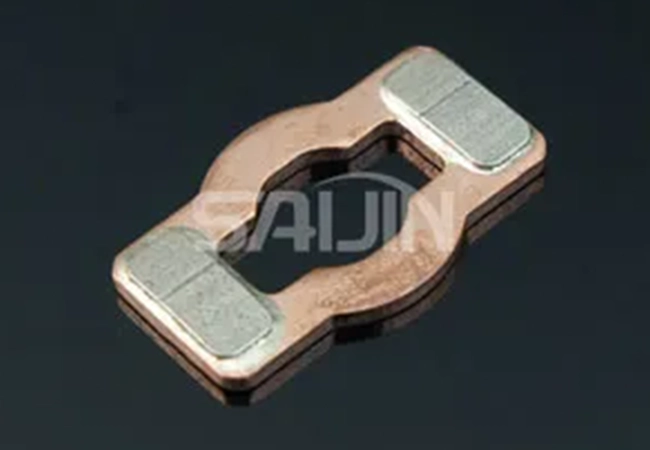
You're holding a switch contact that looks like one solid piece — a silver alloy face on a brass carrier, with no visible seam. But that joint was made by laser welding, and the depth of the weld determines whether the contact stays attached after ten thousand thermal cycles or separates in the field. A Welded Stamping Parts assembly joins the silver contact to the stamped carrier at a weld depth of ≥0.3mm, creating a metallurgical bond that holds under vibration and current load. This article explains how the weld depth is controlled, what tensile strength the joint delivers, and what to verify when you're sourcing welded silver-on-carrier contacts for switch and relay production.
Why Does Weld Depth Determine Joint Survival?
Beyond Surface Adhesion
A weld that only penetrates the surface creates an adhesive bond rather than a metallurgical one. Surface-level joining can look acceptable at incoming inspection and still fail months later when the contact heats and cools repeatedly. The silver and brass expand at different rates, and a shallow joint fatigues at the interface until it separates.
Laser welding at ≥0.3mm depth pushes the melt zone into both the silver alloy and the carrier substrate. The resulting joint is a mixture of the two metals at the boundary, not a layer of solder or braze sitting between them. That mixed zone is what survives the expansion and contraction cycles without developing a crack path along the interface.
What the Weld Depth Means for Contact Resistance
The electrical path from the silver contact face to the carrier runs through the welded zone. A deep, fully fused weld presents a large cross-section to the current, which keeps resistance low. The welded assemblies hold contact resistance below 0.5 mΩ. If the weld is shallow or contains voids, the effective conductive area shrinks, resistance rises, and the joint becomes a hot spot under continuous load.
What Tensile Strength Does the Joint Deliver?
200N Pull-Off and Vibration Exposure
The welded joint is rated for 200N tensile strength. That figure matters in automotive relays and industrial controllers, where the contact assembly experiences vibration from the vehicle chassis or the machine frame. A 200N joint holds the silver contact in place even when the assembly is subjected to sustained vibration and shock.
The joint also has to survive the staking or insertion force during switch assembly. If the weld is weaker than the assembly force, the contact can shift or separate before the switch ever reaches the customer. The 200N rating provides margin above the forces typically encountered during terminal insertion and housing assembly.
Thermal Cycling and Dissimilar Metal Expansion
Silver and brass have different coefficients of thermal expansion. Every heating and cooling cycle strains the joint at the interface. A deep weld distributes that strain across a larger volume of fused metal, reducing the stress at any single point. That distribution is why the weld depth and the tensile strength are linked — a deeper weld carries more load before the interface begins to fatigue.
| Parameter | Welded Stamping Parts Specification |
|---|---|
| Joining method | Laser welding |
| Weld depth | ≥0.3mm |
| Contact resistance | <0.5 mΩ |
| Tensile strength | 200N |
| Silver plating thickness | ≥3μm |
| Impact resistance improvement | 40% over conventional design |
| Structure | Fully solid |
| Silver alloys | Pure Ag, AgNi10, AgCdO, AgSnO2, AgC3 |
| Carrier materials | Copper, brass |
| Typical applications | Automotive relays, industrial controllers, high-voltage switches, 5G base station/grid |
Which Silver Alloys and Carriers Pair in the Weld?
Matching Alloy to Switching Duty
The silver alloy determines the contact's arc resistance and welding resistance. Pure silver offers the highest conductivity for low-to-medium loads. AgNi10 adds nickel for better arc erosion resistance in relays that switch frequently. AgCdO provides strong welding resistance for demanding loads. AgSnO2 is the cadmium-free alternative for higher-current applications. AgC3 is used where a specific balance of arc resistance and conductivity is required.
The alloy choice also affects weldability. Some silver alloys fuse more readily with brass than others, and the laser parameters are adjusted for each material pair to achieve the ≥0.3mm depth without cracking or porosity.
Copper and Brass Carriers
The carrier is typically copper or brass, stamped to the terminal or spring geometry the switch requires. Copper provides higher conductivity; brass offers higher mechanical strength and better formability for complex stamped shapes. The carrier surface must be clean and oxide-free before welding, because surface contamination interferes with the melt zone and reduces the effective weld depth.
Where Do Welded Silver Contacts Get Used?
Automotive Relays, Industrial Controllers, and High-Voltage Switches
Welded stamping parts with silver inlays show up wherever a contact has to survive vibration and thermal cycling without separation. That includes automotive relays, where the vehicle environment subjects every joint to road-induced vibration and engine-bay heat. Industrial controllers use the same welded construction for contactors and control switches that cycle continuously. High-voltage switches rely on the deep weld to carry current without resistance drift.
The same construction supports 5G base station and grid applications, where customized shapes and material combinations are available. The common thread is a joint that has to remain electrically and mechanically stable through a long service life.
Solid Structure and Impact Resistance
The fully solid design improves impact resistance by 40% over conventional alternatives. That improvement matters in relays and contactors that experience mechanical shock during operation or transport. A solid welded assembly has no internal cavity or bond line to crack under impact, so the contact face stays aligned with the mating contact.
A Welded Stamping Parts supplier like Saijin produces these assemblies with laser welding, automated optical inspection, and material pairing options that cover pure silver through AgSnO2. The ≥3μm silver plating on the contact surface provides a stable interface, while the weld depth ensures the joint survives the thermal and mechanical loads of switch duty.
What Should You Check Before Specifying a Welded Contact?
How do I confirm the weld depth is adequate?
Ask for cross-section data or destructive test results that show the actual weld penetration into both the silver alloy and the carrier. The ≥0.3mm figure is a minimum, and the supplier should demonstrate that production parts consistently meet or exceed it. A visual inspection of the joint line doesn't reveal weld depth — only a cross-section or a pull test does.
What tensile test should I specify?
A 200N pull-off rating is the baseline. For higher-vibration applications, specify a pull test at the rated force and a vibration test that simulates the service environment. The test should be performed on finished assemblies, not on coupons, because the stamping and welding process affects the joint as much as the material selection.
How do I choose between brazing and welding?
Brazing uses a filler metal that melts at a lower temperature than the parent metals, creating a bond through a filler layer. Welding fuses the parent metals directly. For silver-on-brass contacts, laser welding produces a metallurgical joint without a filler layer, which eliminates the filler as a potential failure point. Brazing remains an option for geometries that are difficult to weld, but the welded joint generally offers higher tensile strength and better thermal fatigue resistance.
What inspection data comes with the lot?
Ask for dimensional inspection, weld depth verification, contact resistance measurement, and tensile test results. Saijin uses automated optical inspection with 3D morphology reconstruction for key parameters. For automotive programs, the IATF 16949 production system provides the process control documentation that tier-one suppliers require.
Straight Answers on Welded Silver Contacts
Can the weld depth be increased beyond 0.3mm?
Yes, depending on the material thickness and the laser parameters. A deeper weld increases the fused volume and the tensile strength, but it also increases the heat input and the risk of distortion in thin carriers. The optimal depth is a balance between joint strength and carrier integrity, and the supplier should tune the process for the specific material pair and geometry.
What causes contact resistance to rise in a welded joint?
The most common causes are insufficient weld depth, porosity in the melt zone, and surface contamination before welding. A shallow weld concentrates current in a small area, raising resistance and temperature. Porosity reduces the conductive cross-section. Oxide or oil on the carrier surface prevents full fusion. All three are controlled by process discipline, not by material selection alone.
Can different silver alloys be welded to the same carrier?
Yes, but the laser parameters change. Each alloy has a different melting range and reflectivity, so the weld schedule is developed for the specific alloy-carrier pair. A schedule that works for AgCdO on brass may not produce the same depth on AgSnO2 on copper. The supplier should provide the weld schedule validation for each combination you plan to use.
How does the silver plating interact with the weld?
The silver plating on the contact surface is separate from the silver alloy body. The plating provides a stable contact interface, while the weld joins the alloy body to the carrier. The plating is applied after welding or in a way that doesn't interfere with the weld zone. If the plating extends into the weld area, it can affect the melt behavior and should be accounted for in the process design.
Let's Match a Welded Contact to Your Switch Design
Share Your Alloy, Carrier, and Load Requirements
A Welded Stamping Parts assembly should match your switching current, arc duty, carrier geometry, and vibration environment — not the other way around. The Accessories for Switches with silver inlay for welding from Saijin use laser welding at ≥0.3mm depth, hold contact resistance below 0.5 mΩ, and deliver 200N tensile strength with a fully solid structure that improves impact resistance by 40%. The silver alloy can be specified as pure Ag, AgNi10, AgCdO, AgSnO2, or AgC3, with copper or brass carriers and ≥3μm silver plating. If you're sourcing welded silver contacts for automotive relays, industrial controllers, or high-voltage switches, send us your alloy, carrier, and load requirements — we'll help you confirm the right configuration before you order.