 English
 Chinese
 Pусский
 Español
You're specifying contact components for a relay, contactor, or thermal controller, and the connection needs to withstand vibration, thermal cycling, and millions of switching cycles. A welded stamping part that fails prematurely becomes a reliability issue that can take down an entire system. Saijin's laser-welded components combine precision stamping and silver alloy welding to deliver reliable performance: contact resistance below 0.5 mΩ, tensile strength of 200 N, and weld penetration of ≥0.3 mm. This article walks through what makes these components genuinely reliable—from the laser welding process that creates a metallurgical bond to the precision stamping that ensures consistent geometry.
Questions Engineers Ask About Welded Stamping Parts
Two Practical Concerns—Answered Up Front
Q: Why choose welded stamping parts over riveted contacts?
A: A riveted or staked contact relies on a mechanical interlock that can relax under thermal cycling—the silver contact button can detach from the copper carrier after thousands of cycles. Laser welding creates a metallurgical bond that does not relax, with tensile strength exceeding 200 N compared to 50-100 N for staked connections.
Q: What are the critical performance specifications for welded stamping parts?
A: Three specifications define reliability: contact resistance below 0.5 mΩ for efficient current transfer, tensile strength of 200 N to withstand mechanical stress and vibration, and weld penetration depth of ≥0.3 mm to ensure a strong, durable bond.
Laser Welding vs. Riveting — The Attachment Method That Matters
The attachment method determines whether a contact component will fail prematurely or outlast the equipment it serves. Laser welding offers clear advantages over mechanical staking and traditional brazing.
Why Staked Contacts Fail
A staked or riveted contact uses a mechanical interlock—the carrier is deformed around the contact to hold it in place. Under thermal cycling, the interlock relaxes, and the contact can loosen or detach. Tensile strength is typically only 50-100 N.
Why Laser Welding Outperforms Brazing
Brazing uses a filler metal that melts at a lower temperature than the base materials. The entire assembly must be heated to the melting point of the filler, which can anneal the stamped spring arm and reduce its spring force. Laser welding fuses the silver alloy and copper carrier directly, without a filler metal. The heat-affected zone is localized to the weld spot, leaving the surrounding material unaffected.
| Attachment Method | Bond Type | Typical Tensile Strength | Heat Impact on Base Metal | Failure Mode |
|---|---|---|---|---|
| Staking / Riveting | Mechanical | 50-100 N | None | Loose over time |
| Brazing (silver solder) | Metallurgical (filler) | 100-150 N | Anneals spring arm | Filler creep, joint cracking |
| Resistance Welding | Metallurgical (direct) | 150-200 N | Localized | Electrode wear |
| Laser Welding | Metallurgical (direct) | 200-300 N | Minimal | None within design life |
Three Critical Specifications — The Metrics That Define Reliability
Three technical specifications define the performance of welded stamping parts. Each plays a critical role in ensuring the component performs reliably over millions of cycles.
Contact Resistance: <0.5 mΩ
Contact resistance below 0.5 mΩ ensures efficient current transfer with minimal heat generation. Low resistance means less power loss at the connection point, which is especially important in high-current applications. For automotive relays and industrial controllers, this specification directly affects system efficiency and reliability.
Tensile Strength: 200 N
A tensile strength of 200 N confirms the weld joint can withstand mechanical stress and vibration without failure. This strength ensures the silver contact remains securely attached to the stamped base, even under repeated switching and harsh operating conditions.
Weld Penetration: ≥0.3 mm
Weld penetration depth of ≥0.3 mm ensures a strong, metallurgical bond between the silver alloy and the base material. Proper penetration prevents the contact from separating under stress and maintains consistent electrical performance.
Material Selection — The Combination That Delivers Performance
The performance of a welded stamping part depends on the materials used for both the contact surface and the carrier.
Silver Alloys for the Contact Surface
The contact surface uses silver alloys such as AgNi10 (resistivity ≤2.1 μΩ·cm) or AgCdO. These materials offer low and stable contact resistance, excellent arc resistance, and high conductivity. For relays, contactors, and switches, this translates to reliable switching even under heavy loads.
Brass and Copper Carriers for Mechanical Strength
The stamped base is typically made from brass, copper, or stainless steel. These materials provide the mechanical strength and formability needed for complex shapes, while maintaining good conductivity. The combination of silver alloy contact and brass carrier delivers both electrical and mechanical performance.
Silver Plating for Corrosion Protection
A silver plating layer of at least 3 μm is applied to critical areas, with an optional 5 μm coating available for extreme environmental applications. This plating enhances corrosion resistance, maintains low contact resistance, and protects against wear.
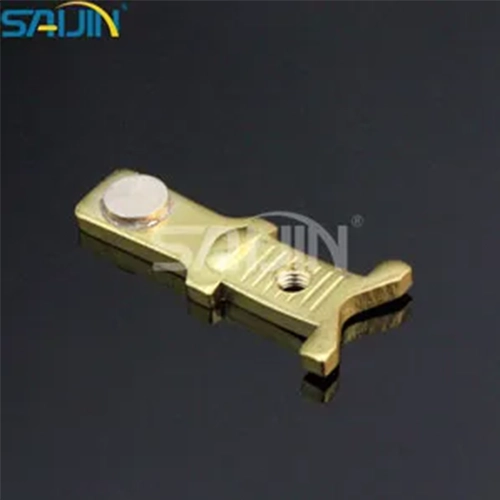
Progressive Die Stamping with In-Process Welding
Saijin combines precision progressive die stamping with automated silver alloy welding in a single integrated process. This approach delivers consistent quality and eliminates the handling steps that can introduce variability.
Precision Stamping for Consistent Geometry
Progressive die stamping ensures that each component meets the same dimensional tolerances. Consistent geometry means consistent electrical performance and reliable assembly.
Automated Welding for Repeatable Quality
Automated laser welding eliminates the variability of manual processes. Each weld achieves the same penetration depth, the same bond strength, and the same contact resistance. The weld does not crack during subsequent heat treatment because the bond is continuous.
Where Welded Stamping Parts Are Deployed
Welded stamping parts are essential for demanding applications where reliability is critical:
Automotive Relays and Contactors
In automotive electrical systems, components face constant vibration, temperature cycling, and high current loads. Welded stamping parts with <0.5 mΩ contact resistance and 200 N tensile strength maintain reliable connections under these conditions.
Industrial Controllers and Thermal Controllers
Industrial controllers and thermal controllers require contacts that can handle millions of switching cycles. The laser-welded metallurgical bond does not relax over time, ensuring consistent performance throughout the component's service life.
5G Base Station and Grid Applications
The technology is also applicable to 5G base station and grid applications. Customized shapes and material combinations are available for these specialized applications, where reliability and performance are non-negotiable.
Straight Answers on Welded Stamping Parts
Q: What is a welded stamping part?
A: A welded stamping part is an electrical contact component where a silver alloy contact is laser-welded to a stamped copper or brass carrier, creating a metallurgical bond.
Q: What are the key performance specifications?
A: The three critical specifications are contact resistance below 0.5 mΩ, tensile strength of 200 N, and weld penetration depth of ≥0.3 mm.
Q: Why is laser welding better than riveting or brazing?
A: Laser welding creates a metallurgical bond without a filler metal, achieving tensile strength of 200-300 N compared to 50-100 N for staked connections. The heat-affected zone is localized, so the spring arm temper is not affected.
Q: What materials are used in welded stamping parts?
A: The contact surface uses silver alloys such as AgNi10 or AgCdO. The carrier is typically brass, copper, or stainless steel. Silver plating of ≥3 μm is applied for corrosion protection.
Q: What applications are welded stamping parts suitable for?
A: They are used in automotive relays, industrial controllers, thermal controllers, 5G base stations, and grid applications.
Q: Who manufactures these components?
A: The components are manufactured by Wenzhou Saijin Electrical Alloy Co., Ltd. , which specializes in contact rivets, contact points, contact components, electrical accessories, and silver alloy wires.
Request a Quote for Your Welded Stamping Project
A welded stamping part that combines precision stamping, laser welding, and rigorous performance specifications is the foundation of any reliable electrical switching component. Saijin's laser-welded components deliver contact resistance below 0.5 mΩ, tensile strength of 200 N, and weld penetration of ≥0.3 mm—all in a package optimized for high-vibration environments like automotive relays and industrial controllers.
Whether you're specifying contacts for relays, contactors, thermal controllers, or 5G applications, Saijin offers the material expertise and manufacturing capability to deliver welded stamping parts that meet your exact requirements. With the ability to customize shapes, material combinations, and plating thickness (3 μm or 5 μm), Saijin is a reliable partner for your electrical component needs.
Contact Saijin for a quote or technical consultation → their team can help you select the right material combination, welding process, and specifications for your specific application requirements. Get a welded stamping part that delivers reliable performance every time.