 English
 Chinese
 Pусский
 Español
You're specifying electrical contacts for a relay, a micro switch, or a contactor. The contact material directly determines switching reliability, contact resistance stability, and service life. A solid silver contact offers excellent conductivity but comes at a high cost. A tri-metal rivet contacts offers a smarter alternative: a three-layer composite structure that delivers the performance of silver where it matters—on the contact surfaces—while using copper for the core where it doesn't. This guide covers how tri-metal rivet contacts are constructed, what makes AgSnO2 the preferred surface material, and how to choose the right configuration for your switching application.
What a Tri-Metal Rivet Contact Is – and How It Differs from Bi-Metal
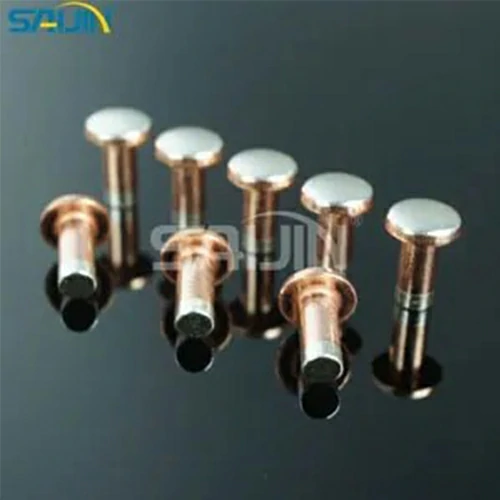
Tri-metal rivet contacts are an upgrade from the bi-metal structure. In a bi-metal rivet, only the head is clad with a silver alloy; the shank remains copper. In a tri-metal rivet, both the head and the base end of the shank are clad with a silver alloy, while the core retains a highly conductive copper substrate. This means the rivet has precious metal on both ends—the head that makes the primary contact and the shank end that may also serve as a contact surface in certain switching configurations.
The Gradient Metallurgical Process
The key to tri-metal performance is the bonding interface between the silver alloy layer and the copper core. The gradient metallurgical process ensures a strong, durable bond that prevents delamination. The result is a composite structure that combines the superior conductivity and arc resistance of silver with the mechanical strength and cost-effectiveness of copper.
Double Side Contact Capability
Because both ends are clad with silver alloy, tri-metal rivets are typically used as double side contacts. This makes them particularly valuable in relay and switch designs where the contact needs to function on both ends—common in applications with moving contacts that engage on either side.
Why AgSnO2 – The Cadmium-Free Contact Material
The AgSnO2/Cu/AgSnO2 configuration is one of the most popular tri-metal combinations. AgSnO2 (silver-tin oxide) has become the preferred alternative to cadmium-containing materials like AgCdO.
Environmental Compliance Without Performance Trade-Off
AgSnO2 is an ideal environment-protecting material for substituting AgCdO. It meets RoHS requirements while delivering comparable—and in some cases superior—electrical performance. The tin oxide content provides better thermal stability and higher hardness than CdO.
Arc Resistance and Anti-Welding Properties
The AgSnO2 contact layer offers excellent resistance to arc erosion. In high-current switching applications, the arc generated when contacts open can cause material transfer and contact welding. AgSnO2's high hardness and thermal stability reduce material transfer and lower the risk of contact adhesion (welding) caused by high arc temperatures.
Extended Contact Life
The special formulation and treatment of the silver alloy in the contact head optimizes its hardness and resistance to arc erosion. This makes the contacts more robust against arcs generated by frequent switching, reducing wear and extending lifespan.
Material Savings – Why Tri-Metal Costs Less Than Solid Silver
The economics of tri-metal rivets are straightforward: you use precious metal only where it's needed.
Localized Use of Precious Metal
In a tri-metal rivet, the silver alloy is only present on the contact surfaces—the head and the shank end. The bulk of the rivet—the core—is copper, which is significantly less expensive than silver. This localized use of precious metal effectively saves material costs.
30-50% Cost Savings
Compared to solid silver contacts, tri-metal rivets can deliver 30-50% cost savings while maintaining the same functional performance. The copper core provides the mechanical strength and conductivity needed for the bulk of the rivet, while the silver alloy cladding delivers the surface performance required for reliable switching.
No Compromise on Performance
Despite the cost savings, tri-metal rivets do not compromise on electrical or mechanical performance. The silver layer thickness and distribution are precisely controlled, ensuring consistent contact resistance and reliable switching over the life of the device.
Performance That Matters – Conductivity, Strength, and Reliability
Tri-metal rivet contacts deliver measurable performance advantages that make them the preferred choice for demanding switching applications.
High Conductivity
The silver-based alloy surface layer ensures contact resistance that is lower than traditional materials. This reduces energy loss and temperature rise during switching. The copper core provides excellent bulk conductivity, ensuring efficient current transmission through the rivet body.
Arc Resistance and Anti-Welding
The special silver alloy contact layer possesses excellent resistance to arc erosion, suppressing arc-induced ablation during switching. It can withstand thousands of opening and closing impacts while maintaining a smooth surface, effectively preventing contact adhesion caused by the arc.
Mechanical Strength and Automated Riveting
The copper core gives the trimetal rivet ideal ductility and strength. During automated riveting, the rivet deforms uniformly, ensuring a firm connection with the contact piece and preventing vibration-resistant loosening.
High Temperature Operation
Tri-metal electric rivet contacts can operate stably in environments up to 250°C. The composite structure of copper and silver also improves corrosion resistance.
Applications – Where Tri-Metal Rivet Contacts Are Used
Tri-metal rivet contacts are found across a wide range of electrical switching devices.
Relays – Industrial Control and Automotive
Tri-metal rivets are widely used in AC contactors, intermediate relays, time relays, and automotive relays. They are key components for reliable circuit switching, particularly in applications where contacts must move or swing.
Micro Switches and Button Switches
The double-side contact capability of tri-metal rivets makes them ideal for micro switches and button switches, where compact size and reliable switching are critical.
Contactors and Circuit Breakers
Tri-metal rivet contacts are used in both fixed and moving contacts of molded-case circuit breakers and air circuit breakers, capable of withstanding short-circuit surges and high-current overloads.
Emerging Applications – EVs and Renewable Energy
Tri-metal rivet contacts are increasingly favored in demanding applications like electric vehicles and renewable energy systems, where reliability and longevity under frequent electrical load are critical.
| Feature | Benefit | Application Impact |
|---|---|---|
| AgSnO2 contact layer | Arc-resistant, anti-welding | Longer contact life in high-current switching |
| Copper core | High conductivity, ductility | Efficient current transmission, reliable riveting |
| Double-side silver cladding | Double side contact capability | Ideal for relays and micro switches |
| Gradient metallurgical bond | No delamination | Consistent performance over millions of operations |
| Up to 250°C operation | High-temperature stability | Suitable for automotive and industrial environments |
What Designers Ask About Three-Layer Composite Rivets
What is the difference between bi-metal and tri-metal rivet contacts?
Bi-metal rivets have a silver alloy cladding only on the head. Tri-metal rivets have silver alloy cladding on both the head and the shank end—making them suitable for double side contact applications.
Why choose AgSnO2 over AgCdO?
AgSnO2 is an environmentally friendly, cadmium-free alternative that meets RoHS requirements. It offers better thermal stability, higher hardness, and comparable arc resistance to AgCdO.
What is the typical silver layer thickness?
Silver layer thickness is controlled at the ±0.001mm level through a gradient metallurgical process. Standard configurations typically have silver layer thickness ranging from 0.3mm to 0.7mm depending on the rivet size.
Can tri-metal rivets be customized?
Yes. Customization includes off-standard sizes, shaped structures, and special performance requirements. Saijin's engineering team provides application consulting, failure analysis, and technical documentation support.
Need a Trimetal Contact That Lasts? Let's Talk Material Options
Selecting tri-metal rivet contacts comes down to three factors: silver alloy type (match your switching environment), silver layer configuration (match your contact design), and dimensional requirements (match your assembly specifications). Contact Saijin for technical support and samples → —their team can help you select the right AgSnO2/Cu/AgSnO2 configuration for your specific relay, switch, or contactor application.
Saijin (Wenzhou Saijin Electrical Alloy Co., Ltd.) has over 20 years of service experience in manufacturing electrical contact components. The AgSnO2/Cu/AgSnO2 Tri-metal Contact Rivets feature silver alloy cladding on both head and shank end with a highly conductive copper core. The gradient metallurgical process ensures silver layer distribution at the ±0.001mm level. Applications include relays, micro switches, button switches, contactors, and circuit breakers. Saijin's products meet RoHS requirements with IATF 16949 certification for automotive applications. Connect with Saijin to discuss your silver alloy material requirements, dimensional specifications, and switching application conditions.