 English
 Chinese
 Pусский
 Español
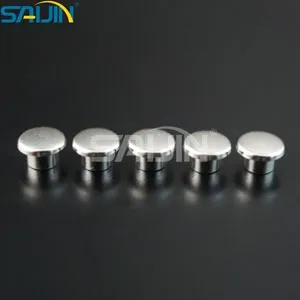
You're designing a relay or a contactor, and the contact material is a critical decision. A silver solid contact rivet is a small, single-piece component that handles the switching duty. It's simple in form—a rivet-shaped piece of metal with a silver alloy head—but its performance dictates the lifespan of the entire device. This guide walks you through the essentials: why "solid" matters, which silver alloys perform best, and how to select the right size and specifications for your application. No unnecessary complexity—just the practical information you need to specify this component with confidence.
Understanding the Solid Construction
A solid contact rivet is made from a single, homogeneous material throughout—unlike composite rivets that combine a precious metal head with a copper base. This fully solid structure provides distinct advantages in mechanical strength and thermal performance. The single-piece design eliminates potential failure points at material interfaces and ensures consistent conductivity across the entire component. Solid construction improves impact resistance by 40% compared to composite alternatives, making it the preferred choice for applications subject to vibration or mechanical shock.
What Makes It "Solid"?
The term "solid" means the rivet is formed from one piece of metal—no cladding, no welding, no joints. This uniformity translates to better heat dissipation, lower electrical resistance, and higher mechanical integrity under stress.
Strength and Conductivity Benefits
Solid rivets handle higher currents without overheating, and they maintain consistent contact pressure even after thousands of switching cycles. In high-vibration environments, the solid structure stays secure, reducing the risk of intermittent connections or contact bounce.
Silver Alloys and Their Performance
Silver is the base material for these rivets due to its exceptional electrical and thermal conductivity. However, pure silver is relatively soft and prone to arc erosion, so manufacturers use silver alloys to balance conductivity with durability. The choice of alloy directly affects the contact's resistance to welding, erosion, and material transfer.
Pure Silver (Ag)
Pure silver offers the highest conductivity but is best suited for low-current, low-arc applications like signal relays and timers, where erosion is minimal.
Silver-Nickel (AgNi)
AgNi is the most common alloy for general-purpose switching. It provides a good balance of conductivity, arc resistance, and cost. As nickel content increases, resistance to welding and erosion improves.
Silver-Tin Oxide (AgSnO₂)
AgSnO₂ is the preferred cadmium-free alternative, offering excellent arc resistance and low material transfer—especially in DC applications. It's widely used in contactors and high-voltage switches.
Silver-Tin Oxide-Indium Oxide (AgSnO₂In₂O₃)
This advanced alloy delivers superior arc erosion resistance and anti-welding properties, making it suitable for the most demanding switching applications.
Key Specifications to Check
When selecting a solid contact rivet, several dimensional and electrical parameters are critical. Head diameter, shank diameter, overall length, and head shape must match the terminal design. Electrical performance depends on contact resistance and current-carrying capacity. Saijin's rivets are available with silver coating thickness of at least 3μm, with an optional 5μm thickness for extreme environments. Dimensional tolerances are held to ±0.05mm, and automated optical inspection ensures consistency.
Standard Size Ranges
Typical head diameters range from 1.0mm to 10mm, with shank lengths up to 8mm. Custom sizes are available to meet specific design requirements.
Common Applications and Suitability
Silver solid contact rivets are used in a wide range of low-voltage switching devices. They're found in relays, contactors, high-voltage switches, thermostats, timers, and auxiliary switches. In each application, the contact must handle hundreds of thousands of operations with minimal degradation. The solid construction and appropriate alloy choice ensure consistent contact resistance and reliable switching over the device's lifetime.
Relays and Contactors
Relays and contactors are the primary applications. The contact rivet is the heart of the switching mechanism, making and breaking the circuit with each operation.
High-Voltage and Automotive Systems
In high-voltage switchgear and automotive electronics, the demands are greater—higher currents, more severe arcing, and stricter safety requirements. Solid rivets with AgSnO₂ or AgNi alloys are often specified for these roles.
Manufacturing Quality and Testing
Quality control is essential because a defective contact can cause field failures. Saijin employs automated inspection equipment with optical 3D measurement and electrical testing to verify 100% of key parameters. Dimensional repeatability is maintained at 0.005mm through CNC machining and automated optical measurement. The defect rate is consistently below 0.1%. All products come with complete material certification, including RoHS and REACH compliance reports and composition analysis.
In-Process Inspection
Raw material verification, hardness testing, dimensional checks, and electrical performance tests are performed at every stage of production.
Traceability and Documentation
Each batch is fully traceable, and customers receive detailed test reports with their shipments, ensuring regulatory compliance and quality assurance.
Customization and Sizing Options
Standard catalog sizes may not fit every application. Saijin offers full customization, from off-standard dimensions to special head shapes and shank configurations. The engineering team works with customers to develop prototypes and validate designs. Production volumes can range from small sample batches to high-volume runs exceeding one billion pieces annually. Standard products ship within 15 working days, with expedited options available.
Design Support
Saijin's engineers provide application consulting, failure analysis, and technical documentation support throughout the development cycle.
Prototyping and Testing
Custom samples are available for testing, with quick turnaround to validate performance before full-scale production.
Top Questions About Silver Solid Rivets
When should I choose a solid rivet over a composite rivet?
Choose solid for high-current applications, high-vibration environments, or where mechanical strength is critical. Composite rivets are more economical when the precious metal is only needed on the surface.
Which silver alloy is best for DC switching?
AgSnO₂ is the preferred choice for DC applications due to its low material transfer and resistance to arc erosion.
How do I verify the quality of a delivered batch?
Check the provided material certification and test reports. For critical applications, you can perform sample testing for dimensions, hardness, and electrical resistance.
What is the typical lifespan of a solid contact rivet?
Lifespan depends on current, switching frequency, and environment. With appropriate alloy selection, solid rivets can last hundreds of thousands to millions of operations.
Request Your Custom Silver Solid Rivets
Selecting the right solid contact rivet comes down to alloy, size, and coating thickness. Get a quote or engineering consultation → —Saijin's team can help you match the right rivet to your application, with samples available for testing.
Saijin (Wenzhou Saijin Electrical Alloy Co., Ltd.), established in 1998, is a specialized manufacturer of contact rivets, contact points, electrical accessories, and silver alloy wires. The Ag Silver Solid Contact Rivets product line features fully solid construction with impact resistance improved by 40% and silver plating thickness ≥ 3μm. Available alloys include Ag, FAg, AgNi, AgSnO₂, AgZno,AgCdo and AgSnO₂In₂O₃, suitable for relays, contactors, high-voltage switches, switchgear, and thermostats. Saijin's production system is IATF 16949 certified. products meet RoHS and REACH requirements, with complete material certification provided. The company offers extensive customization, from off-standard sizes to special performance requirements, supported by an engineering team providing application consulting and technical documentation. Connect with Saijin to discuss your alloy requirements, dimensional specifications, and production volume needs.