 English
 Chinese
 Pусский
 Español
You’re designing a switch — maybe a micro-switch, a rocker switch, or a relay. The contact that makes and breaks the circuit is the heart of the device. It must be precise, durable, and conductive. It must withstand thousands of cycles without failing. The component that delivers these requirements is a stamped part.
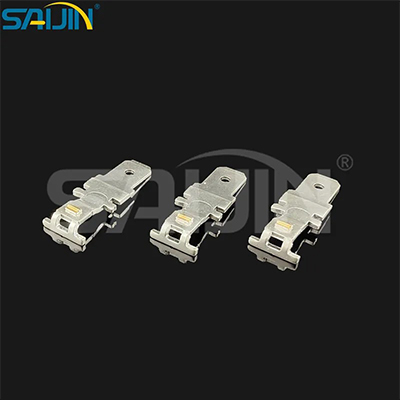
Switch stamped parts are the precision metal components that form the moving and fixed contacts in electrical switches. Saijin‘s advanced stamping processes — including progressive die and fine blanking — produce complex shapes with high dimensional accuracy, minimal waste, and work-hardened structural integrity. This guide covers what makes stamped parts essential for switch performance, how material selection affects reliability, and what customization options are available to fit your specific design.
The stamping process advantage — precision and efficiency
The way a switch contact is manufactured determines its performance and cost. Stamping offers advantages that machining or casting can‘t match.
Progressive die stamping for complex shapes
Progressive die stamping allows intricate shapes and fine details to be achieved in a single operation, reducing secondary machining needs. For switch contacts with complex geometries — multiple bends, tabs, or contact points — progressive stamping delivers consistent quality across millions of parts. The process minimizes waste by optimizing raw material usage, often through progressive or fine blanking techniques.
Work hardening for structural integrity
The stamping process itself enhances the metal‘s properties. Work hardening during stamping can increase the structural integrity of metal parts without additional heat treatments. For switch components that must maintain their shape and contact force through thousands of cycles, this natural strengthening is a significant advantage.
High precision and consistency
Saijin‘s automated optical inspection system achieves three-dimensional morphology restoration with repeatability of 0.005mm. This level of precision ensures that every stamped part meets the dimensional requirements of the switch design — and that the switch performs consistently from the first cycle to the millionth.
Material selection — phosphor bronze and silver alloys
The choice of material determines the switch‘s conductivity, durability, and contact force stability. Two material families dominate switch stamped part applications.
Phosphor bronze — the balanced performer
Phosphor bronze is the standard material for switch stamped parts. It offers a combination of good conductivity, high fatigue resistance, and excellent spring properties. For switch contacts that must maintain consistent contact force over millions of cycles, phosphor bronze is the proven choice. Saijin‘s material lab ensures that each batch meets industry standards for arc oxidation resistance, exceeding typical specifications.
Silver alloys — when conductivity and arc resistance are critical
For switch contacts that carry higher currents or operate in demanding environments, silver alloy surfaces are applied to the stamped base. Silver’s low contact resistance and arc resistance ensure reliable switching. Saijin offers silver alloy contacts with resistivity as low as ≤2.1 μΩ·cm for AgNi10, with options for lower resistance through special formulations. Silver coating thickness is at least 3μm, with optional 5μm for extreme environments.
Custom material combinations for special requirements
Not every switch uses standard materials. Saijin supports non-standard sizes, shaped structures, or special function requirements — such as multi-contact integration or miniaturized design. The engineering team provides application consulting throughout the product development cycle.
Customization and quality assurance
Every switch design has unique requirements. Saijin‘s capabilities cover the full spectrum from prototyping to high-volume production.
Automated optical inspection and dimensional accuracy
100% inspection is carried out through CNC machining centers and automated optical measurement systems with repeatability of 0.005mm. The fully automatic optical inspection system achieves three-dimensional morphology restoration, ensuring that every part meets the specified dimensions and tolerances.
Production automation and consistency
Complete automatic production lines achieve 99.99% process consistency, ensuring that every stamped part — from the first to the millionth — is identical. This consistency is essential for switch manufacturers who need reliable performance across large production volumes.
Questions about switch stamped parts
Q: What is the minimum order quantity for trial production?
A: Saijin supports various order quantities from small sample batches to large-scale production, providing flexible options to meet different research and manufacturing needs.
Q: How do you ensure quality consistency?
A: Saijin implements closed-loop quality management, integrating customer feedback, conducting regular process audits, and continuously optimizing testing protocols. Automated optical inspection with 0.005mm repeatability ensures every part meets specifications.
Q: What certifications are available?
A: The production system has passed IS09001 certification, and some products meet automotive grade reliability standards. All goods come with a complete material certification package, including RoHS and REACH compliance reports.
Q: What is the typical delivery time for standard products?
A: Standard products are usually shipped within 25-30 working days after order confirmation. Urgent requests can be provided with expedited options.
Below is a quick reference table for stamped part material properties:
| Material | Key Property | Best Application |
|---|---|---|
| Phosphor bronze | Fatigue resistance, spring properties | General switch contacts |
| Phosphor bronze + silver alloy | Low contact resistance, arc resistance | High-current or high-cycle switches |
| Special copper alloys | Higher conductivity | Low-voltage, high-current applications |
| Silver alloy (AgNi10) | Resistivity ≤2.1 μΩ·cm | High-performance relays and switches |
How Saijin supports your switch component design
Saijin has been manufacturing electrical metal components with advanced stamping processes for over 20 years. The company‘s range of switch stamped parts utilizes precision metal stamping and custom moulding techniques to produce high-precision components for different types of switches.
Customized services include technical support and consulting, sample verification, and production flexibility. From off-standard sizes and shaped structures to special performance requirements, Saijin offers deeply customized metal stampings and electrical connection components for customers around the globe.
Before you specify stamped parts for your next switch design, consider the application‘s current rating, switching frequency, and environmental conditions. The right material, precision, and customization ensure that your switch performs reliably for its intended service life.
Ready to evaluate switch stamped parts for your next design? Contact Saijin for a consultation, sample verification, or rapid prototyping. Share your design requirements, material preferences, and production volume — their team can recommend the right stamped part solution for your specific application.