 English
 Chinese
 Pусский
 Español
You're specifying electrical contacts for a relay or a switch. The datasheet shows the dimensions and the material. But what really determines whether the component will perform reliably over millions of cycles? The answer lies in three critical parameters: contact resistance, tensile strength, and weld penetration depth.
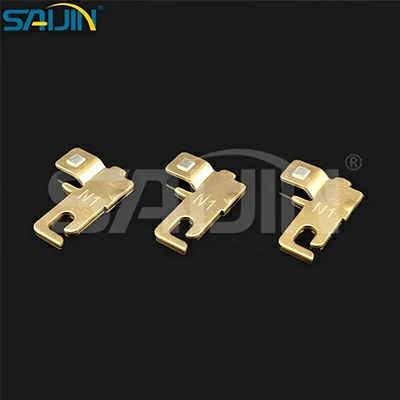
Welded stamping parts are only as reliable as their core specifications. Saijin's components consistently achieve contact resistance below 0.5 mΩ, tensile strength of 200 N, and weld penetration depth of ≥0.3 mm. These metrics define the component's ability to carry current efficiently, withstand mechanical stress, and maintain integrity over its service life. This guide covers the essential performance requirements of welded stamping parts, how they're measured, and why they matter for your application.
The three specs that determine reliability
Three technical specifications define the performance of welded stamping parts. Each one plays a critical role.
Contact resistance: the conductor's efficiency
Contact resistance below 0.5 mΩ ensures efficient current transfer with minimal heat generation. Low resistance means less power loss at the connection point, which is especially important in high-current applications. For automotive relays and industrial controllers, this specification directly affects system efficiency and reliability.
Tensile strength: the joint's durability
A tensile strength of 200 N confirms the weld joint can withstand mechanical stress and vibration without failure. This strength ensures the silver contact remains securely attached to the stamped base, even under repeated switching and harsh operating conditions. The high tensile strength directly contributes to the component's long service life.
Weld penetration: the bond's integrity
Weld penetration depth of ≥0.3 mm ensures a strong, metallurgical bond between the silver alloy and the base material. Proper penetration prevents the contact from separating under stress and maintains consistent electrical performance. Saijin's laser welding process achieves this penetration consistently across production runs.
Below is a quick reference table for the critical performance metrics:
| Parameter | Specification | Why It Matters |
|---|---|---|
| Contact resistance | <0.5 mΩ | Minimizes heat generation and power loss |
| Tensile strength | 200 N | Withstands vibration and mechanical stress |
| Weld penetration depth | ≥0.3 mm | Ensures strong, durable bond |
| Impact resistance | 40% improvement | Survives harsh operating environments |
| Silver plating thickness | ≥3μm (optional 5μm) | Protects against corrosion and wear |
What makes the silver alloy contact work
The contact surface determines the electrical performance. The material and its properties are key.
Silver alloys for low resistance
The contact surface uses silver alloys such as AgNi10 (resistivity ≤2.1 μΩ·cm) or AgCdO. These materials offer low and stable contact resistance, excellent arc resistance, and high conductivity. For relays, contactors, and switches, this translates to reliable switching even under heavy loads.
Silver plating for protection and conductivity
A silver plating layer of at least 3μm is applied to critical areas, with an optional 5μm coating available for extreme environmental applications. This plating enhances corrosion resistance, maintains low contact resistance, and protects against wear. For automotive and outdoor applications, the thicker plating provides additional durability.
Brass and copper carriers for mechanical strength
The stamped base is typically made from brass, copper, or stainless steel. These materials provide the mechanical strength and formability needed for complex shapes, while maintaining good conductivity. The combination of silver alloy contact and brass carrier delivers both electrical and mechanical performance.
Where welded stamping parts are used
Reliable performance specifications make welded stamping parts essential for demanding applications.
Automotive relays and contactors
The harsh environment—vibration, temperature extremes, and exposure to moisture—demands robust components. Welded stamping parts meet these demands while offering cost-effective manufacturing for high-volume production. IATF 16949 certification ensures automotive-grade reliability for many products.
Industrial controllers and switchgear
Industrial control systems require components that can handle millions of switching cycles. Welded stamping parts provide the arc resistance and low contact resistance that these applications demand. The welded joint ensures the contact stays in place under mechanical stress.
5G infrastructure and specialized equipment
Customized shapes and material combinations are available for applications such as 5G base stations and grid infrastructure. Saijin's engineering team can develop custom solutions for specialized requirements, ensuring the component meets the application's unique needs.
Questions engineers ask about performance specs
Q: How is contact resistance measured and verified?
A: Contact resistance is measured using a precision milliohmmeter, typically with a four-wire Kelvin connection to eliminate lead resistance. Saijin performs 100% inspection of key parameters through automated optical 3D measurement and electrical testing, ensuring every component meets the <0.5 mΩ specification.
Q: What affects weld penetration depth?
A: Weld penetration depth is influenced by laser power, welding speed, and material properties. Saijin's laser welding process is optimized to achieve a consistent penetration depth of ≥0.3 mm, verified through cross-section analysis and destructive testing on sample batches.
Q: How does silver plating thickness affect performance?
A: A minimum silver plating thickness of 3μm provides corrosion protection and maintains low contact resistance. For extreme environments—high humidity, salt spray, or aggressive chemicals—an optional 5μm coating offers additional protection. Saijin's silver plating thickness is verified through X-ray fluorescence (XRF) measurement.
How Saijin ensures consistent performance
Saijin has nearly thirty years of experience in manufacturing electrical contacts. The company's welded stamping parts are produced through a complete process flow that includes in-house research and development, fully automated contact inspection, and 100% quality control.
The production system includes automated inspection (optical 3D measurement + electrical testing), with 100% inspection of key parameters and a defect rate below 0.1%. All goods come with complete material certification packages, including RoHS and REACH compliance reports and material composition analysis. Standard products ship within 7-15 working days.
For design engineers and procurement teams, the combination of precision stamping, reliable welding, and rigorous quality assurance makes Saijin a reliable source for welded stamping parts. Before you commit to a large order, request samples and run them through your own performance testing. A few hours of validation now prevents years of field failures.
Ready to evaluate welded stamping parts for your application? Contact Saijin for a consultation, sample verification, or custom development. Share your application type, electrical load, and performance requirements—their team can recommend the right welded stamping part for your specific needs.