 English
 Chinese
 Pусский
 Español
A senior toolmaker at a mid‑sized stamping house was asked to quote a switch contact terminal order. The customer specified a burr height of no more than 0.03mm across a shipment of 500,000 parts. The toolmaker quoted a standard progressive die, estimating a tool life of 50,000 strokes before burr formation exceeded the limit. A competitor — Saijin — quoted the same job with a tool life guarantee of 200,000 strokes before edge quality degraded.The difference was not the steel grade or the press tonnage, but the finishing process applied to the die itself.
In switch stamped parts manufacturing, a single stamping station combines several operations: piercing the pilot holes, blanking the outer contour, coining the contact surface, bending the terminal legs, and cutting the carrier strip. The toolmaker who sets the clearance between punch and die at 8‑10% of material thickness for copper alloys will produce a part with a clean shear zone and a minimal burr. A die with inconsistent clearance or worn cutting edges creates a ragged edge, and the burr will fall off inside the switch housing, cause intermittent contact, and lead to a field failure.
The Saijin process for switch stamped parts uses precision progressive die technology combined with fine blanking for edges that require zero burr, such as the contact face of a silver‑inlay terminal. The press speed is controlled to keep the metal’s strain rate within the range that produces a clean fracture, and the tool steel is coated with titanium carbonitride (TiCN) to reduce adhesive wear from copper alloy transfer. This article walks through why the edge condition of a stamped terminal matters more than the alloy in a high‑vibration environment, how work hardening changes the mechanical properties of the contact arm, and where a 0.005mm repeatability spec pays back on an automated assembly line.
Fine blanking vs. progressive stamping: why the edge condition determines whether a switch terminal stays flat in a 10‑year relay
The edge of a stamped part contains three distinct zones: the rollover, the shear zone, and the fracture zone. For a switch terminal that will be mated with a stationary contact thousands of times, a large fracture zone creates a rough edge that accelerates wear on the opposite contact. A high‑shear edge produced by fine blanking exhibits up to 100% shear with minimal fracture, creating a surface that slides cleanly past its mating part.
Saijin’s switch stamped parts use a hybrid approach: progressive die stamping for the majority of the part geometry, switching to fine blanking for critical edges that will make electrical contact or act as a bearing surface. The tool design allows the blanking punch to penetrate 50‑80% of the material thickness before fracture completes, producing a smoother edge than a conventional die with 15‑25% penetration.
| Edge Finish Method | Shear Zone (%) | Fracture Zone (%) | Best Use |
|---|---|---|---|
| Conventional blanking | 15‑20 | 80‑85 | Non‑contact edges, carrier strip |
| Fine blanking | 80‑100 | 0‑20 | Contact surfaces, sliding wear edges |
| Shaved / coined edge | 60‑80 after secondary | 20‑40 | Post‑stamp improvement for critical fits |
For a terminal that will be inserted into a PCB, a rough edge can scrape the plated through‑hole, damaging the copper barrel. The fine‑blanked terminal enters the PCB with a smooth lead‑in, reducing insertion force and preventing hole damage.
[Image: Cross‑section comparison of conventionally blanked vs fine‑blanked edge on a stamped copper terminal, showing the smooth shear zone of the fine‑blanked sample]
Work hardening during stamping: why the terminal arm stays bent when a machined part springs back
When a strip of copper alloy enters a progressive die, the first station pierces the pilot holes. The second station may coin a silver contact onto the surface. Later stations bend the terminal arm to its final angle. Each hit from the punch work‑hardens the metal at the bend line. The metal’s yield strength increases, and the springback—the tendency of the part to return to its flat shape after bending—is reduced.
In a machined part (cut from a solid block), the grain structure is uniform throughout. Springback is high and must be compensated for in the fixture. In a stamped part (主词加粗第3次), the work‑hardened bend line holds its shape without needing to be over‑bent. A stamped switch terminal with a 30° bend will maintain that 30° angle through heat cycling and vibration better than a machined terminal that has been stress‑relieved.
The processing parameters —stamping speed, punch‑die clearance, and lubrication—determine the depth of the work‑hardened zone. A fast stroke speed concentrates the hardening at the surface, creating a tough skin over a ductile core. A slower speed spreads the hardening through the full thickness, which is preferable for parts that will undergo secondary welding or plating.
48‑hour prototyping: how a die design review at daybreak changed the terminal geometry of a high‑current relay
A relay manufacturer in Germany needed a terminal that could carry 40A continuously without overheating at the crimp. The first prototype — a flat stamped part — was rejected during thermal imaging testing. The terminal’s cross‑section was uniform, and the current crowded at the narrowest point, causing a hot spot.
Saijin’s design team returned a revised quote within 48 hours. The new design tapered the terminal’s cross‑section, widening it at the crimp and narrowing it at the contact tip. The progressive die could still produce the tapered shape using a stepped blanking contour that removed material gradually. The second prototype passed the thermal test, and the relay went into production.
The 48‑hour rapid prototyping capability is not a standard feature of every stamping house. It requires an in‑house toolroom with CNC machining centers, a material inventory covering common copper alloys (C1100, C194, C7025, brass), and a design team that uses simulation software to test formability before cutting steel. Saijin’s prototyping service includes dimensional reports and a sample batch of stamped parts for customer functional testing.
0.005mm repeatability and the assembly line: why a stamped terminal that deviates by 0.03mm will jam the pick‑and‑place machine
An automated relay assembly line feeds stamped terminals from a reel into a placement head. The head picks the terminal, rotates it to the correct orientation, and inserts it into the relay base. If the terminal’s carrier strip has a pitch error of more than 0.02mm, the placement head’s vacuum nozzle will miss the pick‑up point. The machine stops, the operator clears the jam, and the line loses a minute of production.
Saijin’s dimensional control holds repeatability to 0.005mm for terminal pitch and carrier strip hole spacing. The measurement is performed by an automatic optical inspection (AOI) system that compares each part’s 3D geometry to the CAD model, rejecting any terminal that deviates beyond the tolerance band. The system captures the part’s entire surface, measuring flatness, bend angle, edge condition, and hole position in a single pass.
For a reel of 10,000 terminals, an AOI pass rate of 99.99% means the assembly line will encounter one bad part per reel. A pass rate of 99.0% means a jam every 200 parts — equivalent to stopping the line seven times per reel.
IATF 16949 and the audit trail: why an automotive switch supplier needs terminal traceability from coil to carton
A switch that goes into an automotive door latch must be traceable from the finished assembly back to the batch of raw material. If a field failure occurs, the supplier must identify which shift produced the faulty batch and which coil of copper alloy supplied the material.
Saijin’s IATF 16949 certification for its stamped parts line mandates a closed‑loop quality system. Each coil of copper or brass is logged with its mill certificate. The stamping press logs the batch number, the tooling ID, and the operator. The AOI system records the measurement data for every part in the batch. The finished reels are labeled with a traceable QR code. An audit trail that would take an uncertified supplier days to assemble is available from Saijin’s production database in minutes.
For a switch manufacturer who supplies OEMs in the automotive sector — where recalls can cost millions — that traceability is not a value‑add. It is a requirement for bidding.
| IATF 16949 Requirement | How Saijin Complies |
|---|---|
| Product traceability | QR‑coded reels linked to coil certificate and production data |
| Control of nonconforming product | AOI system rejects out‑of‑tolerance parts; separate bin for material recovery |
| Measurement system analysis | AOI calibrated daily; gauge R&R studies performed quarterly |
| Supplier quality management | Complete material certification package (RoHS, REACH) included with each shipment |
Three ways a production engineer uses the material cert package to prevent field failures
Silver plating thickness for coastal environments
A switch installed on a seaside oil rig sees salt spray daily. Standard 3‑micron silver plating (the industry baseline) may corrode at the contact edge after 1‑2 years. Saijin offers an optional 5‑micron silver coating for extreme environments, doubling the corrosion barrier without changing the crimp geometry. The cert package includes a thickness measurement report for each batch.
Resistivity matching for high‑current battery disconnects
A 60A battery disconnect switch needs terminal resistivity below 2.1μΩ·cm to keep the temperature rise under 35°C at full load. Saijin’s AgNi10 alloy specification shows a resistivity of ≤2.1μΩ·cm, and the cert package includes a resistivity test report. The production engineer compares that number to the switch’s thermal derating curve before signing off on the design.
Strand retention for crimped terminals
A terminal that is crimped rather than soldered must have a barrel that closes without extruding wire strands. The material cert for Saijin’s copper alloy terminals includes the oxygen content and hardness range — two parameters that affect how the copper flows under the crimping force. High‑oxygen copper can crack during crimping; Saijin’s low‑oxygen copper specification eliminates that risk.
How Saijin’s OEM factory electrical silver contact stamping parts fit into a switch assembly line
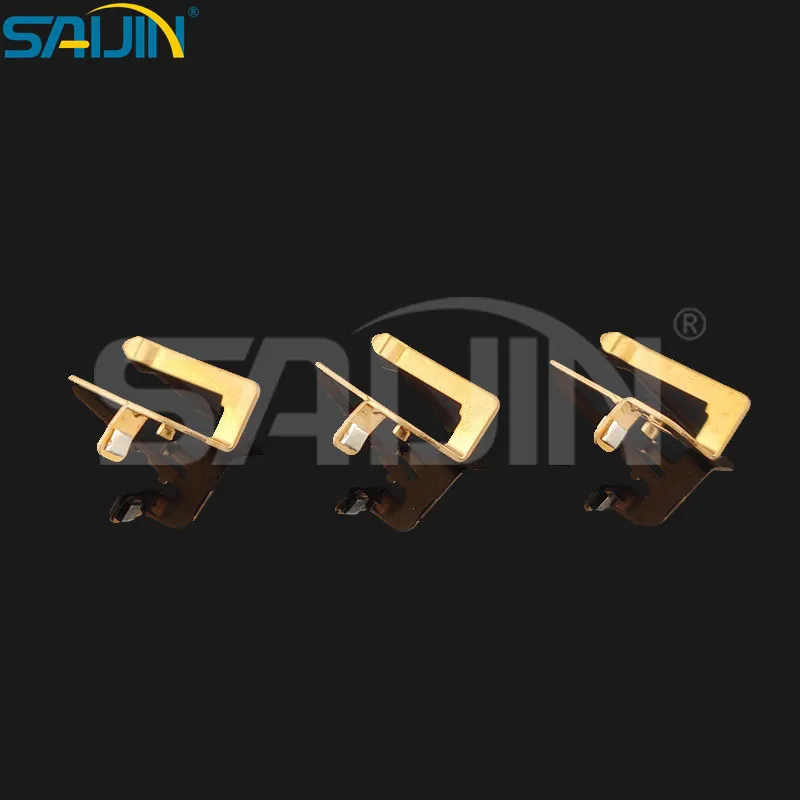
Saijin Electric (Wenzhou Saijin Electrical Alloy Co., Ltd.) has manufactured stamped parts for switches, relays, circuit breakers, and connectors. The OEM stamped line includes custom tooling for customer‑supplied drawings, progressive die and fine blanking capabilities for edge quality, ±0.02mm dimensional tolerance and 0.005mm repeatability, 3‑5μm silver plating on contact surfaces, multiple copper alloy options (C1100, C194, brass, phosphor bronze), 48‑hour rapid prototyping for new designs, IATF 16949 certification for automotive quality traceability, and full material certification packages (RoHS, REACH) included with each shipment.
Delivery for standard parts is 7‑15 days; prototyping turn‑around, smaller than many competitors’ quoting cycles, is available for urgent requests. The tooling is designed for a minimum die life of 200,000 strokes, with wear parts that can be replaced without scrapping the entire die block.
For a switch stamped parts supplier that guarantees 200,000 burr‑free stampings, delivers 48‑hour prototypes, and maintains 0.005mm repeatability under IATF 16949 audit, Saijin’s OEM factory electrical silver contact stamping line delivers the edge finish, work hardening, dimensional control, and traceability that an automated assembly line demands.
【Request a quote from Saijin Electric】
Send Saijin your terminal drawing, annual volume, and material preference to receive a tooling quote, sample reel, and full IATF 16949 certification package.