 English
 Chinese
 Pусский
 Español
Inside every electrical socket, buried behind the plastic housing, is a brass or copper component that does all the real work. It carries the current from the wall to your device. It clamps onto plug pins with spring tension and withstands years of insertion and removal without fatigue. That component is a Socket Stamping Parts — and its design affects everything from contact resistance to safety. A well-designed stamped part maintains consistent contact pressure, resists corrosion, and ensures efficient current transmission. This guide explains what goes into a brass socket stamping part and why it matters.
Why stamping is the go-to process for socket contacts
Stamping — a process where metal sheet is pressed between a die and a punch to create a shape — is the dominant manufacturing method for socket contacts. It’s fast, precise, and consistent. The stamping process uses blanking, punching, bending, drawing, and forming operations to transform sheet metal into highly consistent electrical components. A single progressive die can produce millions of identical parts. Each part replicates the geometry of the die with near-perfect repeatability. That matters because a few tenths of a millimeter in a contact geometry can mean the difference between a plug that fits securely and one that wobbles.
For a socket contact stamped from brass sheet, the stamping process must maintain tight dimensional tolerances. Stamped parts undergo stamping under the premise that the material is not consumed much while achieving uniform part size with the same die and good interchangeability.
Brass: Why this alloy is the industry standard
Brass — an alloy of copper and zinc — combines several properties that are ideal for socket contacts. Copper provides high electrical and thermal conductivity. Zinc adds strength and corrosion resistance. The result is a material that conducts current efficiently while staying rigid enough to maintain spring tension over thousands of insertion cycles.
Saijin‘s socket stamping parts use materials such as copper, brass, phosphorus bronze, and beryllium copper, each selected based on the required conductivity, mechanical strength, and cost target. For standard residential sockets, brass is the default choice. It strikes the right balance between cost and performance, making it suitable for large-volume production while still meeting safety standards for resistance to arc erosion and low heat generation.
What happens when material selection goes wrong
A socket contact made from low-grade brass will fatigue quickly. The spring pressure drops. The plug no longer fits tightly. Loose contacts cause arcing. Arcing generates heat. Heat accelerates oxidation. Eventually, the socket fails or becomes a fire hazard. The material‘s consistency is the first line of defense against these failures.
The role of geometry in contact reliability
The shape of a socket stamping part is not arbitrary. It is engineered to achieve two things. First, the contact geometry creates a specific amount of spring force against the inserted plug pin. Too little force and the plug falls out; too much force and insertion becomes difficult and the material fatigues faster. Second, the geometry determines the contact area between the socket and the plug pin. A larger contact area reduces resistance and heat generation.
Good stamped parts also incorporate features that compensate for tolerance stack-up. If the stamped part is too narrow, it may not grip the plug pin firmly enough. If it is too wide, insertion becomes impossible. The stamping die controls the part’s width with high precision, ensuring consistent fit with standardized plug dimensions.
Testing and quality control that separate good from great
Manufacturing a part to spec is one thing. Verifying that it stays within spec across millions of production pieces is another. Saijin implements several layers of quality control on its socket stamping parts.
| Quality Control Measure | What It Ensures |
|---|---|
| 100% optical inspection | Dimensional accuracy, burr-free edges, no deformation |
| Contact resistance testing | ≤1.2 mΩ at 50A load ensures efficient current transmission |
| Full material certification | RoHS, REACH compliance reports accompany every shipment |
| 100,000-cycle mechanical life test | Verifies durability under repeated plug insertions |
Saijin’s electronic contacts in industrial relays can achieve contact resistance ≤1.2 mΩ at 50A load through precision stamping and composite plating processes, and strictly follow the MIL-STD-883H test standard to ensure they pass 100,000 mechanical life tests under environments ranging from -40°C to 105°C.
Additionally, quality control includes 100% inspection through CNC machining centers and automated optical measurement systems with repeatability of 0.005mm, fully automated inspection (optical 3D measurement + electrical testing), and the maintenance of a defect rate below 0.1%. Certifications such as ISO9001:2015, IATF 16949, and compliance with EU RoHS and REACH requirements are also maintained.
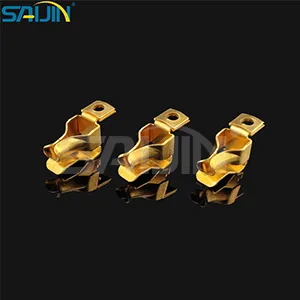
Surface treatment: more than just good looks
Bare brass resists corrosion reasonably well, but it still tarnishes over time. In a damp environment or after years of use, tarnish increases contact resistance. Surface treatments address this. The socket stamping part is often plated with nickel under silver or directly with silver. Silver plating reduces contact resistance and improves wear resistance. The fully solid structure design increases impact resistance by 40%, with a silver plating thickness of ≥3μm suited for relays, contactors, and high-voltage switches supporting high-current transmission.
Tin plating is a lower-cost alternative used in some applications. It provides adequate corrosion protection but does not match silver‘s conductivity. The choice of surface treatment is driven by the application’s current rating, environmental exposure, and cost targets.
Where brass socket stamping parts are used
These components are everywhere — in wall sockets, power strips, industrial connectors, relays, contactors, disconnectors, controllers, timers, and other low-voltage apparatus. In a standard home, every outlet contains at least one stamped brass contact. In industrial settings, socket stamping parts are found in high-current connectors and heavy-duty power distribution equipment. Beyond socket contacts, the stamping of brass components extends to switch mechanisms, terminal blocks, and custom connectors for automotive electronics, industrial equipment, and new energy sectors.
Custom applications vary widely
The stamped part’s requirements vary by application. For low-power electronics, the priority might be low contact resistance to avoid signal attenuation. For a battery-powered forklift, the priority is high-current capability and durability against vibration. Saijin produces stamped parts ranging from off-standard sizes and shaped structures to special performance requirements, creating deeply customized metal stampings and electrical connection components.
How one manufacturer approaches socket stamping parts
One manufacturer with experience in electrical component stamping is Saijin (Wenzhou Saijin Electrical Alloy Co., Ltd.). The company has specialized in producing contact rivets, contact points, contact components, electrical accessories, and silver alloy wires since its establishment in 1998. Their Brass Socket Stamping Part is made via stamping equipment including high-speed stampers, riveting machines, welding automation, with quality verified by tools like coloured metallography, microscopes, and 3D coordinators.
Saijin serves customers including Schneider, Haier, Panasonic, Chnt, Bahra Cables, Apator, FEB, and Amper Auto, with an annual output that can surpass one billion pieces. The company has been awarded as a Zhejiang Province scientific and technological enterprise since 2016, and its products are also found in automotive electronics, industrial equipment, and new energy sectors. The company holds ISO9001:2015 and IATF 16949 certifications, and uses cadmium‑free materials to meet EU RoHS and REACH requirements.
Questions from engineers and procurement specialists
Can socket stamping parts be made to non‑standard sizes and shapes?
Yes. Saijin supports deep customization of off‑standard sizes, shaped structures, and special performance requirements, offering deeply customized metal stampings and electrical connection components.
What material certifications are provided?
All goods from Saijin come with a complete material certification package, including RoHS compliance reports, REACH compliance reports, and material composition analysis. The production system has passed IATF 16949 certification. For specific plating thicknesses or special alloy compositions, those requirements can be discussed at the quoting stage.
How can I verify the quality of stamped parts before ordering a large volume?
Request stamped part samples and run them through your assembly process before scaling up. Test for insertion force, retention force, and conductivity. A good supplier will provide material certifications and dimensional inspection reports along with the samples.
What determines the life expectancy of a socket contact?
Life expectancy depends on three factors: contact geometry, material spring properties, and surface treatment. A well-designed brass contact can survive 10,000 insertion cycles. Silver-plated contacts with optimized geometries exceed that range.
Are brass stamped parts interchangeable with copper or beryllium copper in the same die design?
Die geometry is material‑specific. Brass, copper, and beryllium copper have different spring constants and formability. A die designed for brass may produce parts with different spring forces if run with a different alloy. Mechanical and electrical performance must be re‑qualified when changing material.
A final word on a part that’s easy to overlook
Socket Stamping Parts do not appear in product brochures. They are hidden inside walls, inside power strips, and inside industrial equipment. But their performance determines how safely and efficiently electricity flows. A stamped part made from the right material, with the right geometry, and with proper surface treatment will outlast the equipment it is installed in. The stamping process that creates it is not glamorous. But it is precise, consistent, and proven — and for socket contacts, that precision makes all the difference.
【Request a quote from Saijin for the Brass Socket Stamping Part】 — Share your target electrical rating, plug standard (e.g., EU, UK, or US), and annual volume requirements. Their engineering team will review material options and provide stamped samples for testing.