 English
 Chinese
 Pусский
 Español
You're specifying contacts for a new relay design. The switching frequency is high. The current is significant. Solid silver contacts would work — but they'd cost more than your budget allows. Copper contacts would be cheaper, but they'd oxidize and fail long before the expected service life.
A silver inlay stamping part solves that problem. It puts silver exactly where it's needed — on the contact surface — while the rest of the component uses copper or brass. You get the conductivity and arc resistance of silver without paying for silver where you don't need it. This guide covers what silver inlay stamping parts are, where they're used, and why they're becoming the standard choice for high-volume electrical component manufacturing.
Silver where it counts, copper where it doesn't
Solid silver contacts are expensive because you're paying for silver throughout the entire component. Silver inlay stamping parts put the silver only where it counts.
The silver stops at the surface
The silver layer is applied to the contact surface — the only area that actually makes electrical connection. With a silver layer thickness of ≥5μm and bond strength over 50MPa, these components provide stable performance in high frequency switching applications. The rest of the component uses copper, brass, or phosphor bronze — materials that provide the structural strength and formability that silver alone can't deliver.
Silver performance without the silver price tag
Silver inlay stamping parts save precious metal without sacrificing performance. The composite effect produces very useful comprehensive performance — especially the electrical properties and wear resistance — while saving precious metals and reducing product costs. For high-volume production, those material savings add up fast.
Works like solid silver, costs like a smart compromise
The silver inlay provides the same conductivity and low contact resistance as solid silver. The contact resistance is typically below 0.5 mΩ, with tensile strength reaching 200 N. The result: the same electrical performance as solid silver, at a lower cost.
Where silver inlay parts actually end up
Silver inlay stamping parts are used wherever reliable switching is required. The list is long and growing.
Relays, contactors, and high-voltage switches
Relays and contactors need contacts that can handle frequent switching without degrading. Silver inlay stamping parts are widely used in relays, contactors, and high-voltage switches. The silver contact surface provides the low resistance and arc resistance that these applications require.
Switches, thermostats, and breakers
Wall switches, thermostats, micro-switches, and circuit breakers all rely on silver contacts for reliable operation. Silver inlay stamping parts are used in wall switches, protectors, thermostats, micro-motor brushes, commutators, and micro-switches.
EV relays and battery systems
The automotive industry is one of the fastest-growing markets for silver inlay stamping parts. Saijin's production system has passed IATF 16949 certification, and some products meet automotive grade reliability standards. For EV main relays, charging relays, and battery management systems, the combination of performance and cost-effectiveness makes silver inlay stamping parts the preferred choice.
Appliances, meters, and control switches
Timers, auxiliary switches for household appliances, control switches, and smart meters all use silver inlay stamping parts. In consumer products, cost matters — and silver inlay stamping parts deliver the right balance of performance and price.
Below is a quick reference table for common applications and requirements:
| Application | Key Requirement | Why Silver Inlay Works |
|---|---|---|
| Relays | High-frequency switching | Silver contact surface handles arc wear |
| Circuit breakers | Fault current interruption | Silver's low resistance minimizes heating |
| Contactors | High current, frequent operation | Silver layer provides consistent conductivity |
| Thermostats | Temperature cycling | Silver resists oxidation at elevated temperatures |
| Automotive switches | Vibration + high current | Bond strength >50MPa keeps contacts secure |
| Smart meters | Long life, low maintenance | Silver's wear resistance extends service life |
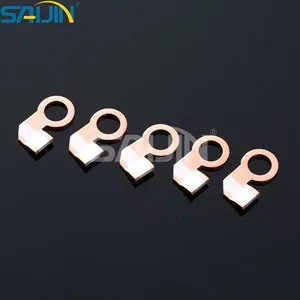
Three things that separate good from bad
Not all silver inlay stamping parts are created equal. The differences show up in performance and service life.
50MPa bond strength — it stays put
The bond between the silver layer and the copper substrate must withstand thermal cycling, vibration, and mechanical stress. Bond strength over 50MPa ensures that the silver stays where it belongs — on the contact surface. Weak bonding leads to delamination, which creates high resistance and eventual failure.
5μm minimum — thick enough to last
Silver layer thickness of ≥5μm is the standard for high-frequency switching applications. Thinner layers wear through faster, exposing the copper substrate and increasing contact resistance. For extreme environmental applications, optional 5μm coating is available.
0.005mm precision — feeds right every time
Dimensional accuracy is critical. Components are inspected through CNC machining centers and automated optical measurement systems with repeatability of 0.005mm. 100% inspection of key parameters keeps the defect rate below 0.1%. For automated assembly lines, that precision matters — a part that's 0.1mm off spec won't feed properly.
The edge matters more than the alloy
The edge condition of a stamped terminal matters more than the alloy in a high-vibration environment. Saijin's process uses precision progressive die technology combined with fine blanking for edges that require zero burr — such as the contact face of a silver-inlay terminal. A high-shear edge produced by fine blanking creates a surface that slides cleanly past its mating part. A rough edge accelerates wear on the opposite contact and can lead to field failure.
Four questions buyers always ask
Q: Inlay vs. plating — not the same
A: Silver plating applies a thin silver layer to the surface of the finished part. It's effective but can wear through over time. Silver inlay embeds the silver into the substrate during the material formation process, creating a thicker, more durable silver layer that won't peel or flake. The bond strength of inlay (over 50MPa) is significantly higher than plating adhesion.
Q: Copper, brass, bronze — what goes underneath
A: The substrate can be copper, brass, phosphor bronze, beryllium copper, nickel, iron, or stainless steel. The choice depends on the application requirements — formability, strength, conductivity, and cost. Copper and brass are the most common for electrical applications.
Q: AgNi, AgCdO, AgSnO — which one is right
A: Surface materials include silver, silver nickel (AgNi10), silver copper, silver cadmium oxide, and silver tin oxide. The AgNi10 alloy has a resistivity of ≤2.1 μΩ·cm, with lower resistance options available through special formulations. The choice depends on the switching load and environmental conditions.
Q: Yes — IATF 16949 certified
A: Saijin's production system has passed IATF 16949 certification, and some products meet automotive grade reliability standards. They're used in EV main relays, charging relays, and battery management systems. For automotive applications, verify the specific part's qualification status.
Q: Start with the load, end with the spec
A: Start with your application requirements — switching frequency, current load, operating temperature, and environmental conditions. Then define the substrate material, silver alloy, layer thickness, and dimensional tolerances. Saijin offers customized solutions from off-standard sizes and shaped structures to special performance requirements. Request samples and test them in your actual application.
The supplier that makes the difference
Saijin has nearly thirty years of experience in manufacturing electrical contacts. The company's silver inlay stamping parts are produced through a complete process flow that includes in-house research and development, automated contact inspection, and 100% quality control.
The production system uses precision progressive die technology combined with fine blanking for critical edges — such as the contact face of a silver-inlay terminal. Tool steel is coated with titanium carbonitride (TiCN) to reduce adhesive wear from copper alloy transfer. Press speed is controlled to keep the metal's strain rate within the range that produces a clean fracture. The result: components that outlast competitors by four times the strokes.
Quality control includes 100% inspection of key parameters through optical 3D measurement and electrical testing, with a defect rate below 0.1%. All goods come with complete material certification packages, including RoHS and REACH compliance reports. Standard products ship within 7-15 working days.
For electrical component buyers and design engineers, the combination of material optimization, precision manufacturing, and quality assurance makes Saijin a reliable source for silver inlay stamping parts. Before you commit to a large order, request samples and run them through your own testing. A few hours of validation now prevents years of field failures.
Need silver inlay stamping parts for your next project? Contact a supplier for samples or a quote on copper stamping parts with silver inlay. Share your application type, current load, and dimensional requirements — their team can recommend the right configuration for your specific application.