 English
 Chinese
 Pусский
 Español
A 5‑micron silver‑brazed phosphor bronze spring connector rated for 10,000+ mating cycles still fails at cycle 3,200. A silver‑inlay terminal that passed every lab test begins to show contact resistance drift after six months in the field. A switch assembly that survived vibration profiling on the bench develops intermittent discontinuity when installed on a forklift.
These failures have a common cause: what designers don’t see on the data sheet. Field experience across thousands of switch applications has repeatedly demonstrated that the reliability of a Switch Stamped Parts assembly is not determined by one dominant property but by the balance of four interdependent factors: material and electrical performance, contact force stability, environmental tolerance, and manufacturing precision. Each of these areas hides failure mechanisms that lab tests routinely miss.
This guide examines the four reliability gateways that separate switch stamped parts that last from those that fail early—without resorting to overspecifying or guesswork.
Gateway 1 – Material and Electrical Performance
The starting point for any reliable switch stamped part is the base metal. Yet material selection is often narrowed to two extremes: “copper” (conductive but soft) or “beryllium copper” (strong but expensive and brittle during forming). Between these lies a range of copper alloys that offer the right balance.
What the data sheet won’t tell you about alloy choice. Phosphor bronze (CuSn4–CuSn8) provides the best all‑around combination for switch springs and connectors: good conductivity, excellent fatigue resistance, and reasonable formability. The tin content determines the spring properties—higher tin (CuSn6–CuSn8) delivers stronger spring back but reduces conductivity. For high-cycle applications (switch contacts that operate thousands of times daily), fatigue resistance matters more than raw conductivity.
A phosphor bronze strip that meets the nominal alloy composition can still fail early if the temper is wrong for the application. Half‑hard (H02) is suitable for moderate spring force; spring temper requires the tightest grain structure for maximum cycle life. Saijin’s process for switch stamped parts uses precision progressive die technology combined with fine blanking for edges that require zero burr, such as the contact face of a silver‑inlay terminal.
The role of silver content. Silver‑inlay or silver‑brazed contacts provide the low‑resistance interface at the switching point. But silver thickness is often overlooked. A 1–2 µm silver layer may pass initial contact resistance tests but will wear through after tens of thousands of cycles, exposing copper and causing resistance to rise sharply. Saijin specifies a minimum silver coating thickness of 3 µm, with an optional 5 µm coating for extreme environmental applications.
Conductivity without fragility. Brass (CuZn alloys) offers good conductivity at lower cost but lacks the fatigue resistance needed for moving contacts. For stationary contacts or low‑cycle applications, brass is acceptable. For any application involving spring action or repeated flexing, specify phosphor bronze or beryllium copper.
Gateway 2 – Contact Force Stability
A switch works because a spring-loaded contact presses against a stationary contact with sufficient force to break through surface oxides and maintain a low-resistance path. That force must remain stable over the switch’s service life.
Stress relaxation – the silent killer. Copper alloys lose spring force over time when held under constant deflection. This phenomenon, called stress relaxation, is temperature‑accelerated. A contact spring that provides 150 g of force at 25°C may deliver only 90 g at 85°C after 1,000 hours. If the initial force was marginal, the contact will fail prematurely. Field failure analysis shows that contact pressure decreases even at low mileage, and finite element analysis demonstrates that contact pressure decreases during the assembly process of multifunction switches.
Specify with thermal margin. For applications in warm environments (automotive interiors, industrial control panels, appliances), overspecify initial contact force by 25‑30% to account for stress relaxation over the product’s service life. For applications with expected contact forces, Saijin offers silver alloy wires with different conductivity properties developed for different applications.
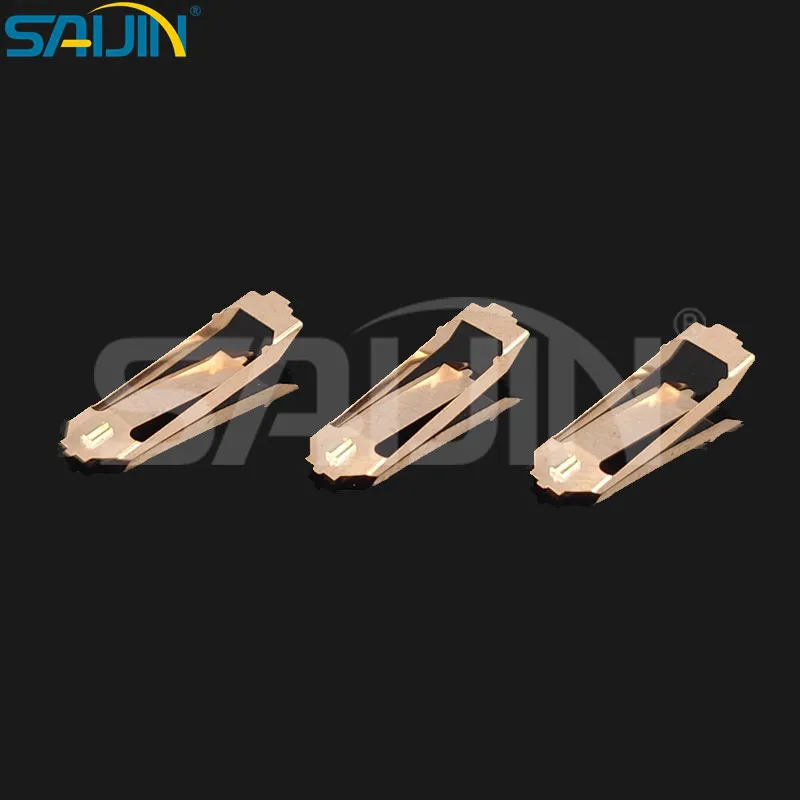
Contact geometry matters as much as force. A rounded contact surface concentrates force into a smaller area, creating higher pressure at the interface and better oxide penetration. A flat contact spreads the force, increasing the risk of high-resistance connections. Saijin‘s precision progressive die technology ensures consistent contact geometry across millions of parts
Gateway 3 – Environmental Tolerance
Heat, humidity, salt, and industrial pollutants attack switch contacts in ways that are difficult to replicate in laboratory testing.
The corrosion pathway. Silver tarnishes (forms silver sulfide) in the presence of sulfur‑containing gases—common in industrial areas and near highways. Silver sulfide is conductive, unlike copper oxide, but its surface resistance is higher than pure silver. For low‑voltage, low‑current circuits (logic-level signals, sensor inputs), even a thin tarnish layer can cause intermittent failures.
Copper corrosion leads to mechanical failure. The copper or brass spring element itself can corrode in humid or salt‑spray environments. When the spring arm corrodes, its cross‑section reduces, and the spring force drops. Saijin‘s silver coating thickness is at least 3 µm, and an optional 5 µm coating is available for extreme environmental applications.
Galvanic incompatibility. When different metals contact each other in the presence of an electrolyte (moisture containing salt or industrial pollutants), galvanic corrosion occurs. Silver‑plated contacts paired with unplated copper springs create a galvanic couple. The less noble metal (copper) corrodes preferentially. Always specify that both contact surfaces have compatible platings, or apply conformal coating over the entire switch assembly.
Gateway 4 – Manufacturing Precision
The best material selection and design are wasted if the part isn’t made correctly. For switch stamped parts, three manufacturing parameters determine reliability.
Burr control. The stamping process inevitably creates a small burr on the sheared edge. Where that burr is located determines whether it causes a problem. A burr on the contact face creates uneven pressure and accelerates wear. A burr on the spring hinge can create a stress riser that leads to fatigue cracking. Saijin uses progressive die stamping for the majority of the part geometry, switching to fine blanking for critical edges that will make electrical contact or act as a bearing surface.
Inspection and traceability. Dimensional accuracy ensures that parts assemble correctly and maintain their designed contact force. Saijin uses 100% inspection through CNC machining centers and automated optical measurement systems with a repeatability of 0.005 mm. Full material certification packages, including RoHS and REACH compliance reports and material composition analysis, accompany all goods.
Plating adhesion. Silver plating that flakes or peels is worse than no plating. Flakes can migrate and cause short circuits. Plating adhesion depends on proper cleaning before plating. Saijin‘s silver coating thickness is at least 3 µm, ensuring consistent performance across millions of parts.
What Stamped Part Fits Your Switch?
Low‑cycle, low‑current switches (door switches, limit switches, appliance interlocks). Brass or low‑tin phosphor bronze with silver or tin plating. Dimensional accuracy is important, but extreme fatigue resistance is not required. Saijin supports non‑standard sizes, shaped structures, and special function requirements including multi‑contact integration and miniaturized design.
High‑cycle, low‑current switches (push‑button switches, micro‑switches). Phosphor bronze (CuSn6‑CuSn8) with silver‑inlay or silver‑brazed contact. Spring temper required. The process optimizes raw material usage through progressive or fine blanking techniques, and work hardening during stamping can enhance structural integrity without additional treatments.
High‑current switches (relays, contactors, power switches). High‑conductivity copper or beryllium copper for the spring element, with silver‑brazed or silver‑inlay contact. Plating thickness of 3 µm minimum, 5 µm for harsh environments. Silver alloy resistivity is ≤ 2.1 μΩ·cm, with lower resistance options available through special formulations.
Automotive and harsh environment switches. IATF 16949 certification ensures automotive‑grade production quality, and some products meet automotive‑grade reliability standards.
Why Saijin‘s Switch Stamped Parts Start With Precision
When a switch assembly must survive hundreds of thousands of operations without failure, the manufacturing precision and process control are as important as material selection.
Saijin‘s range of Switch Stamped Parts utilises advanced stamping processes to ensure excellent reliability and durability of each part. Through precise metal stamping and custom moulding techniques, Saijin produces a wide range of high‑precision stamped parts for different types of switches. Design capability supports non‑standard sizes, shaped structures, and special function requirements. The material lab’s arc oxidation resistance life exceeds industry standards by 200%.
Production automation achieves 99.99% process consistency with fully automatic optical inspection systems for three‑dimensional morphology restoration. The mould workshop guarantees mould life exceeding 200,000 stampings. Rapid prototyping is available in 48 hours with flexible production line clusters.
Nearly 30 years of experience in manufacturing electrical contacts supports Saijin‘s complete process flow, from silver alloy wire development in‑house to final assembly. The company holds IATF 16949 certification for automotive‑grade production and provides full material certification packages including RoHS and REACH compliance reports.
→ Request a quote from Saijin for Silver Brazed Electrical Contact Phosphor Copper Spring Connector — Share your application (switch type, current rating, cycle life target), operating environment, and required dimensions. Their engineering team provides application consulting, failure analysis, and technical documentation throughout the product development cycle.