 English
 Chinese
 Pусский
 Español
You're designing the contact system for a circuit breaker, and the cost of silver is a line item you can't ignore. Using solid silver for every contact pin works, but it puts precious metal in places where it never touches the mating surface. Silver Inlay Stamping Parts change that equation by bonding a thin silver layer only where the contact happens, leaving the rest of the pin as copper or brass. This article explains how the inlay process works, what material combinations are available, and what to verify before specifying a silver inlay contact pin for your breaker design.
How Does the Inlay Process Concentrate Silver Where It Matters?
The inlay process starts with two separate strips: a precious metal tape and a base metal tape. The precious metal tape becomes the contact surface, and the base tape becomes the body of the stamped part. Through thermal composite molecular diffusion, the two strips are bonded into a single functional material. The silver is not plated or welded on the surface—it becomes an integral layer of the strip. When the strip is stamped into a contact pin, the silver layer ends up exactly where the contact is made, and the copper base carries the current and provides the mechanical structure. This selective placement is what saves precious metal without sacrificing contact performance.
Diffusion Bonding Creates a Continuous Metallic Interface
The bond between the silver layer and the copper base is metallurgical, not adhesive. Atoms diffuse across the interface, creating a continuous transition zone. The strip can be stamped, bent, and riveted without delamination, because there is no discrete boundary to fail. The electrical and thermal properties transition smoothly from the contact surface to the base.
Silver Layer Thickness Determines Cost and Life
The thickness of the silver inlay controls both the material cost and the contact life. A thicker silver layer resists arc erosion longer, but uses more precious metal. A thinner layer reduces cost but may wear through faster under high switching loads. The right balance depends on the breaker's interrupting rating, the expected number of operations, and the acceptable contact resistance over the device lifetime.
What Material Combinations Are Available for Different Switching Loads?
Silver Inlay Stamping Parts can combine a range of surface and base materials to match the electrical and mechanical demands of the application. The surface material determines arc resistance and contact resistance. The base material determines conductivity, strength, and spring properties. Standard surface options include gold, gold alloy, silver, silver nickel, silver copper, silver cadmium oxide, and silver tin oxide. Base materials include pure silver, silver alloy, copper, brass, phosphor bronze, beryllium copper, zinc white copper, nickel, iron, and stainless steel.
Silver Nickel for Repetitive Switching
Silver nickel resists arc erosion and welding under medium and small currents, making it suitable for breakers that switch frequently. It maintains stable contact resistance over thousands of operations, which is critical for devices that must stay within calibration limits.
Silver Tin Oxide for Higher Interrupting Ratings
For breakers that must interrupt higher fault currents, silver tin oxide provides greater arc erosion resistance. The trade-off is slightly higher contact resistance, which is usually acceptable in devices where the contact force is high enough to break through surface films.
How Is the Composite Strip Manufactured for Consistent Bonding?
The composite strip is produced by advanced thermal composite molecular diffusion technology. The complex tape and base tape are rolled together under heat and pressure, allowing the atoms at the interface to diffuse and form a metallurgical bond. The resulting strip is then stamped into the final contact pin geometry. The manufacturing process includes die-cutting, stacking, and precision stamping. Tolerances are held to ±0.10mm on head diameter, ±0.05mm on head thickness, and -0.02/0mm on shank diameter. These tolerances ensure that the pin fits the breaker mechanism and maintains consistent contact force.
Roll Bonding Produces a Uniform Silver Layer
Roll bonding distributes the silver layer evenly across the width of the strip. The thickness is controlled to within a few microns, so every stamped pin receives the same amount of silver. This uniformity is what makes the contact resistance predictable from part to part.
Stamping Without Delamination
Because the bond is metallurgical, the strip can be stamped at high speed without the silver layer separating from the base. Mechanical or adhesive bonds would fail under the shear forces of stamping. Diffusion bonding eliminates that failure mode.
Which Low-Voltage Devices Benefit From Silver Inlay Components?
Silver inlay stamping parts are used in low-voltage electrical equipment where contact performance and material cost both matter. Circuit breakers, relays, wall switches, protectors, thermostats, micro-motor brushes, commutators, micro switches, and connectors all use silver inlay contact pins or similar stamped components.
-
Circuit breakers — moving and stationary contacts that must interrupt fault current without welding
-
Relays and contactors — repetitive switching under inductive loads
-
Wall switches and protectors — high-cycle operation with stable contact resistance
-
Thermostats and temperature controllers — reliable switching over temperature cycling
-
Micro switches and connectors — low-current signal circuits requiring stable contact resistance
Circuit Breakers and Relays
In a circuit breaker, the contact pin carries the full load current and must survive the arc that forms when the breaker trips. Silver inlay pins place the arc-resistant silver layer at the contact point while the copper base carries the current and provides the mechanical strength. This combination delivers the performance of a solid silver contact at a lower material cost.
Switches and Thermostats
Wall switches and thermostats operate thousands of times over their service life. The silver inlay layer resists the erosion that gradually increases contact resistance, keeping the device within specification. The copper base provides the spring properties and mounting geometry that the mechanism requires.
| Parameter | Specification |
|---|---|
| Surface Material Thickness | 0.01 ~ 1.0mm |
| Base Material Thickness | 0.1 ~ 8.0mm |
| Surface Materials | Gold, gold alloy, silver, silver nickel, silver copper, silver cadmium oxide, silver tin oxide |
| Base Materials | Pure silver, silver alloy, copper, brass, phosphor bronze, beryllium copper, zinc white copper, nickel, iron, stainless steel |
| Composite Configurations | Mosaic, double-sided mosaic, full back cover, three composite, side composite |
| Typical Tolerances | Head diameter ±0.10mm, head thickness ±0.05mm, shank diameter -0.02/0mm |
| Silver Layer Thickness | ≥5μm |
| Contact Resistance | <0.5mΩ |
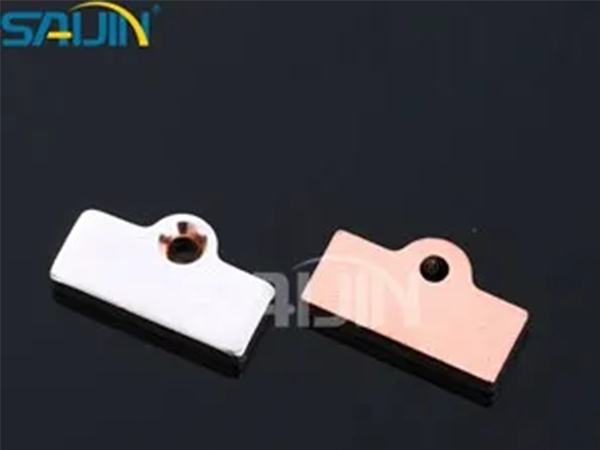
What Specifications Should You Verify Before Ordering?
Before placing an order for silver inlay stamping parts, confirm the surface material and thickness, the base material and thickness, the composite configuration, and the dimensional tolerances. The surface material must match the switching load and the expected life. The base material must provide the required conductivity and mechanical strength. The composite configuration—mosaic, double-sided mosaic, full back cover, or side composite—must match the contact geometry of the mating surface. Dimensional tolerances must be tight enough to ensure proper fit and contact force in the breaker mechanism.
Surface Material and Thickness
The surface material determines the arc resistance and contact resistance. Silver nickel is suitable for medium loads; silver tin oxide or silver cadmium oxide for higher loads. The thickness must be sufficient to survive the expected number of operations without wearing through.
Base Material and Mechanical Properties
The base material determines the conductivity and the mechanical strength of the pin. Copper and brass are the standard choices. Phosphor bronze or beryllium copper add spring properties for applications where the contact must maintain pressure over many cycles.
Common Questions About Silver Inlay Contact Parts
What is the difference between silver inlay and silver plating?
Silver inlay bonds a solid silver layer to the base metal through diffusion. Silver plating deposits a thin silver coating on the surface. Inlay provides a thicker, more durable silver layer that resists arc erosion better than plating, and it does not suffer from the porosity or adhesion issues that can affect plated surfaces.
Can silver inlay parts be used in DC circuit breakers?
Yes. Silver inlay contact pins perform well in DC breakers because the silver layer resists arc erosion and maintains stable contact resistance. DC arcs do not self-extinguish at zero crossings, so the contact must be sized appropriately for the DC load and the expected number of operations.
How do I choose between silver nickel and silver tin oxide?
Silver nickel is suitable for medium-current switching with repetitive operations. Silver tin oxide is better for higher interrupting ratings where arc erosion resistance is the priority. The choice depends on the breaker's rating and the expected fault current.
What testing can be performed on the finished pins?
Silver inlay stamping parts can undergo material hardness testing, assembly line random inspection, automatic contact detection, and projection detection to verify dimensions and contact geometry. Contact resistance can be measured to confirm it meets the <0.5mΩ specification.
Request a Silver Inlay Stamping Part Configuration
Silver Inlay Stamping Parts made from copper and silver deliver the contact performance of a precious metal surface with the cost and mechanical benefits of a base metal core. Saijin produces these parts using thermal composite molecular diffusion bonding and precision stamping, with surface thickness from 0.01mm to 1.0mm, base thickness from 0.1mm to 8.0mm, and silver layer thickness of ≥5μm. Contact Saijin for a silver inlay stamping part configuration assessment → their team can review your drawings, recommend the right material combination and thickness ratio, and produce samples for validation. Get a Silver Inlay Stamping Parts solution that puts silver only where the contact happens—so your circuit breaker performs reliably without paying for precious metal where it doesn't.